The best play environments that encourage fine motor practice keep materials visible and within a child’s reach. They also give children a stable surface to work on and offer pieces that range from big and easy to grab through to small and fiddly. The layout of a room, a backyard or a classroom corner decides how often small hands get used, and it matters as much as which toys are in it.
Most fine motor advice online is a list of activities. Activities help, but they depend on an adult setting them up, and a child will only do so many of them in a day. A well-arranged environment works differently. It invites a child to pinch, sort, thread, tear and pour on their own, many times a day, because the materials are sitting right there and look interesting. Below we cover how our occupational therapists think about setting up spaces at home and outdoors, along with where screens fit in and what an OT actually looks at when families raise concerns.
Why the room matters more than the toy box
Fine motor skills are the small, precise movements of the hands and fingers. Holding a pencil, doing up buttons, opening a lunchbox and using scissors all depend on them. Australia’s national school-entry survey, the Australian Early Development Census, counts these skills as part of physical health and wellbeing, alongside a child’s physical readiness for the school day and their independence with self-care. In the 2024 census, 10.0% of Australian children starting school were developmentally vulnerable in this physical area (AEDC, 2024).
That figure covers more than hand skills, so read it carefully. What it does show is that physical readiness for school is a whole-of-day picture. A child’s hands get their practice in the hours spent playing, eating, dressing and helping out. It does not happen in a single weekly activity.
This is where the environment earns its place. Research on loose parts play (open-ended, movable materials such as bottle caps, shells, twigs, buttons, fabric scraps and cardboard) suggests these materials lead to repeated grasping, pinching, sorting and two-handed work. Children also get to choose how hard to make the task (American Journal of Play, 2024). Much of that research is small, and none of it proves that one setup suits every child. The pattern is consistent enough to act on, though. Children practise more when the materials are open-ended and easy to get at.
Setting up play environments that encourage fine motor practice
Our position is simple. Arrange the space so the easiest thing for a child to do is pick something up and start using their hands. Five decisions make most of the difference.
Keep materials visible and within reach
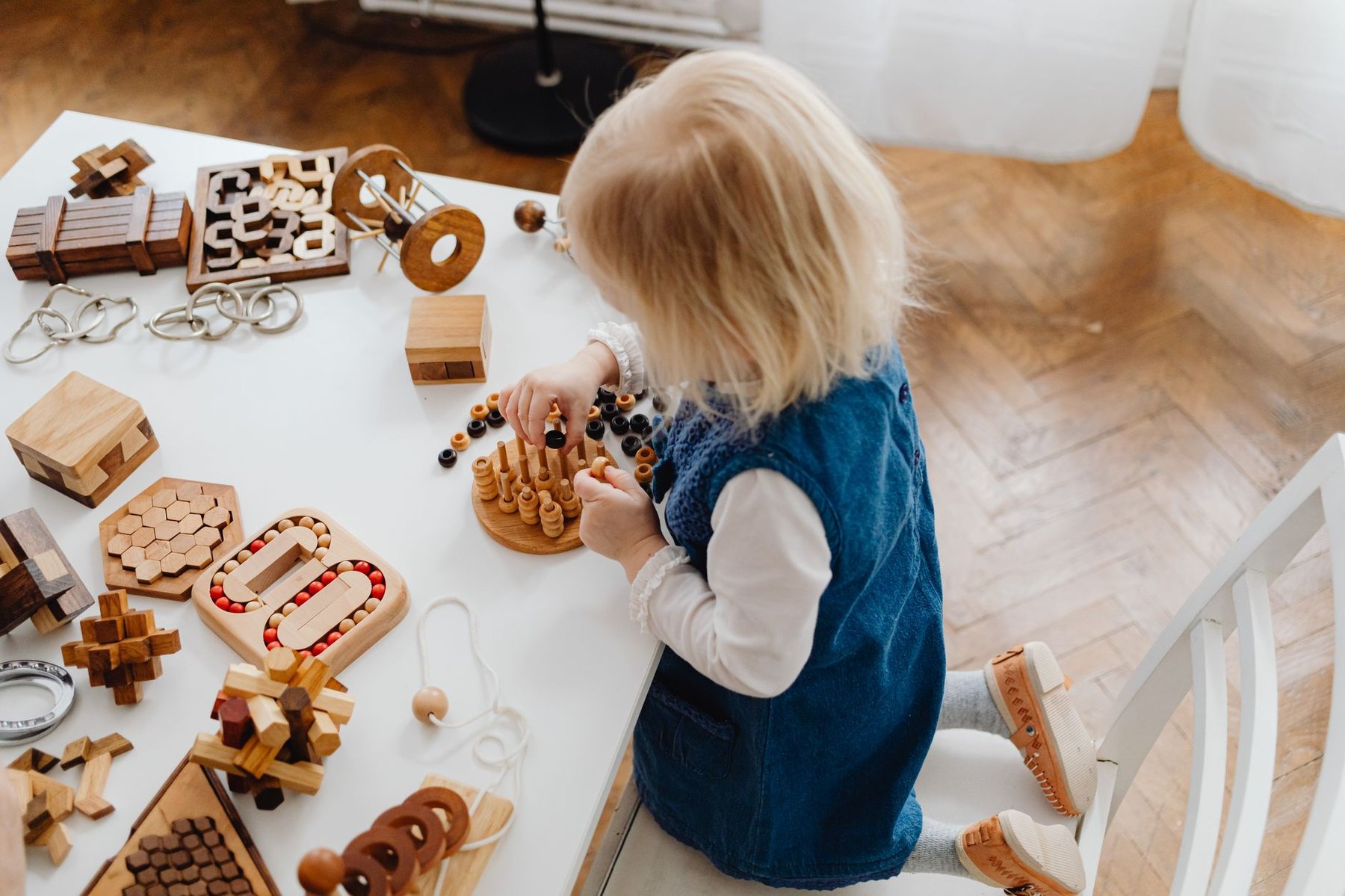
Low, open shelving with clear tubs or shallow trays often works better than a toy chest. A toy chest asks a child to dig, and most will grab the biggest object on top. Open trays let them see the pegs, the threading beads and the playdough tools, so they choose for themselves. Keep a small number of trays out at once. Six well-chosen trays tend to get more use than twenty crowded ones.
A shelf of open trays at hip height does more for small hands than a cupboard full of expensive toys behind a closed door.
Give children a stable surface at the right height
Fine motor work starts at the trunk and shoulder. A child whose feet dangle or whose table sits at chin height spends effort holding their body steady, which leaves less control for the fingers. A small table and chair where feet rest flat on the floor and elbows sit just above the tabletop make a real difference. Working on a vertical surface also helps, such as an easel, a whiteboard on the fridge or paper taped to a wall. It positions the wrist in a way that many children find easier for drawing and early writing.
Sort materials by action, not by toy type
Group things by what the hands do with them. Put threading materials together, building materials together, joining materials (pegs, clips, connectors) together and collage materials together. This makes it easy to rotate one category when interest fades. It also makes it obvious if one kind of hand action is missing from the space altogether.
Offer a range of sizes, textures and resistance
Grading is the step most families skip. Offer chunky pieces alongside small ones, soft playdough alongside firmer clay, and big beads with wide holes next to smaller beads with narrow ones. Children tend to move between levels on their own. A range like this lets a younger sibling and an older child share the same space without either getting bored or frustrated.
As a rough guide by age:
- Babies (6 to 18 months): large objects to grasp and release, and simple posting boxes.
- Toddlers (18 months to 3 years): chunky pegs, big beads and easy-grip tongs.
- Preschoolers (3 to 5 years): smaller beads, child-safe scissors, paper for tearing and lacing cards.
Rotate rather than add
Swap one or two trays every week or so. New materials bring fresh attention without the clutter that comes from constantly buying more. For example, put the threading tray away for a week and bring out a tray of pegs and bulldog clips with a strip of cardboard to clip them onto. A tray is ready to rotate when it has been ignored for several days, or when your child finishes it quickly and easily every time. Stored trays can come back later and often feel new again.
A note on safety and small parts
Small loose parts are a choking risk for babies and young toddlers, and for any child who still mouths objects. Keep small items in a separate, supervised space, or up high and brought out with an adult present. A clear rule we use: if a piece fits easily inside a cardboard toilet roll tube, treat it as a choking hazard for children under three. Supervise water play at all times, however shallow the water.
What each play zone tends to work on
The table below matches common play setups to the hand skills they tend to use. Use it to spot gaps in a space, not as a checklist to complete every day.
| Play zone | Example materials | Hand skills often practised |
|---|---|---|
| Sensory tray | Playdough, kinetic sand, rice, tongs, scoops | Hand strength, squeezing, pinching, tool use |
| Art and collage | Paper to tear, glue sticks, crayons, child-safe scissors | Tearing, pencil grasp, cutting, two-handed coordination |
| Construction | Blocks, interlocking bricks, pegboards, nesting cups | Grasp and release, hand-eye coordination, pressing pieces together |
| Threading and joining | Large beads, pipe cleaners, pegs, lacing cards | Pincer grasp, moving objects within one hand, both hands working together |
| Outdoor dig and pour | Sandpit, buckets, watering cans, small garden tools | Wrist control, pouring, grip strength |
| Everyday helper jobs | Jugs, lunchbox lids, pegs on the washing line, sorting cutlery | Practical strength and precision used in self-care |
Outdoors: backyards, beaches and parks count too
Families across south-east Queensland and the Northern Rivers have an advantage here. Sandpits, beaches, gardens and parks are full of fine motor practice, and children rarely notice they are working. Scooping and pouring sand and water, drawing with chalk on a driveway and collecting shells to sort by size all use the hands. Pulling weeds, planting small seeds and holding swing chains or climbing ropes do the same (Penn State Extension, 2025). A 2025 study on plant materials in outdoor learning spaces adds weight to the idea that natural, loose materials invite detailed hand use (Learning Environments Research, 2025).
To make outdoor play work harder, store a few tools where children can reach them. A crate by the back door with small spades, cups, a watering can, pegs and a bucket for “treasures” turns a backyard into a working space. Bring a small container to the beach for collecting. Hang a peg bag at child height on the washing line and invite children to help.
Movement guidelines back this up. Australian guidance for toddlers and preschoolers recommends at least 180 minutes of physical activity a day, and says not to keep children strapped into prams, car seats or high chairs for more than one hour at a time (Australian Government Department of Health, 2021). Outdoor play that mixes big body movement with small hand tasks covers both needs at once.
Everyday routines are the most underused practice space
The kitchen bench and the bathroom get overlooked as play environments. They shouldn’t be. Pouring water from a small jug, spreading with a blunt knife, peeling a mandarin, opening containers, doing up a zip and squeezing toothpaste all take precision and strength. Because these tasks repeat daily, the amount of practice adds up quickly.
Set these spaces up the same way as a play area. A low step at the bench, a child-sized jug, and clothes stored in drawers a child can open themselves all invite them to have a go. Allow extra time on mornings when nobody is rushing. Independence with self-care is one of the things the national school-entry survey looks at, and everyday routines are where it develops.
Screens: what the evidence actually shows
Screen time is the worry we hear most often, and the evidence is more balanced than headlines suggest. Tapping and swiping are simple, repetitive movements. The bigger concern is what screen time replaces: drawing, cutting, building, dressing and outdoor play.
That changes the practical question. Rather than counting minutes alone, look at what the screen is crowding out of the day. National guidelines recommend no sedentary screen time for children under two and no more than one hour a day for children aged two to five, with less being better (Australian Government Department of Health, 2021). A well-stocked, easy-to-reach play space gives children a genuine alternative when the screen goes off.
What an occupational therapist looks at
When a family or teacher raises concerns about a child’s hand skills, an occupational therapist looks beyond the hands. These are the main areas we observe:
- Grasp patterns: how a child holds crayons, cutlery and small objects, and whether their grasp is changing as they grow.
- Two-handed coordination: whether one hand holds and steadies while the other does the work, as in cutting or opening a jar.
- In-hand manipulation: moving an object within one hand, such as turning a pencil around or shifting a coin from palm to fingertips.
- Hand-eye coordination: how vision guides the hands for threading, drawing and catching.
- Core and shoulder stability: the postural base that steady, precise hand movement depends on.
- Participation: how hand skills affect play, self-care, eating and school tasks in everyday life.
Every child develops at their own pace, and a single tricky skill is not cause for alarm. Questions about an individual child’s development belong with a qualified health professional, such as a GP, child health nurse or occupational therapist, who can look at the full picture.
For children with disability or developmental differences, the environment often needs adapting rather than replacing. Common adaptations include non-slip mats under trays, larger handles on tools, materials with stronger colour contrast, and seating that gives extra trunk support. An occupational therapist can also look at assistive technology where it may help a child take part in play and self-care.
Getting support from an occupational therapist
Because Astrad is a mobile service, our occupational therapists work in the places where children actually play: homes, schools, childcare and community settings. That lets us look at the real shelves, tables and backyards a child uses every day. For families outside our mobile areas, telehealth occupational therapy lets a therapist coach parents and carers through setting up a space using what they already have. This matters for remote families in particular, as vulnerability in physical health and wellbeing rose 1.9 percentage points for children in remote and very remote Australia between 2021 and 2024 (AEDC National Report, 2024).
NDIS participants can access Astrad through plan-managed or self-managed funding. We are not a registered NDIS provider. Decisions about what a plan funds rest with the NDIA, so it is worth talking with your plan manager or support coordinator about how your plan can be used.
If you’d like to talk through setting up a play space, or you have questions about your child’s hand skills, we’re happy to help. Call us on 0468 552 997, email [email protected] or get in touch through the contact page on our website.
Do I need to buy special therapy toys to create a fine motor play space?
No. Many of the most useful materials are already in the house or the backyard, including pegs, bottle lids, cardboard boxes, kitchen tongs, measuring cups, shells and paper for tearing. What matters most is how the materials are stored and offered. Clear trays, a stable table and a mix of easy and harder pieces usually count for more than the price tag of any single toy.
How can I set up a fine motor space in a small apartment?
A single low shelf or a set of stackable clear tubs can work well. Choose three or four trays at a time and rotate them weekly. A wall-mounted whiteboard or paper taped to a door gives you a vertical drawing surface without using floor space, and a balcony tub of sand or water can stand in for a backyard sandpit, with supervision.
Can older siblings and younger children share the same play space safely?
Yes, with some planning. Keep small loose parts on higher shelves or in lidded containers that come out only when an adult is present, and leave chunkier, larger items on the low shelves. Older children can use a separate table for fiddly projects. A clear routine for packing small pieces away also helps keep the shared space safe for younger children.
Is fine motor play still relevant for school-aged children?
Yes. Hand skills keep developing well into primary school, especially for handwriting, cutting, tying shoelaces and managing lunchboxes and school bags. For older children, the environment can shift towards craft kits, model building, cooking tasks, card games and gardening jobs. These activities keep the hands busy in ways that suit their interests and age.
How do I know whether telehealth or a home visit suits my family better?
It depends on your location, your child’s needs and what you hope to work on. Home visits let a therapist see the actual space and how a child uses it, while telehealth can suit families outside mobile areas or those who are comfortable setting things up with guidance on screen. Our team can talk through the options with you before you book.