General Information Disclaimer: This information is general in nature and does not replace an assessment by an occupational therapist or other regulated health professional. It is not a substitute for professional assessment or individualised treatment advice. If you have concerns about your child’s posture, comfort, or workspace set-up, please seek individualised guidance from a qualified health professional, such as an occupational therapist or general practitioner, or speak with your child’s school.
When the Chair Doesn’t Fit, Neither Does Learning
Picture a child settling in to do their homework each evening – shoulders creeping upward, neck craning forward, feet swinging freely above the floor. It may look ordinary, even unremarkable. Yet the way Australian primary students sit at their desks each day is having a measurable impact on their physical wellbeing, their ability to concentrate, and their long-term musculoskeletal health.
Research referenced by Standards Australia indicates that 18–24% of children report back pain at least monthly – a figure that rises significantly into the teenage years. Even more telling, 51.1% of primary school students aged 6–12 report musculoskeletal pain in at least one body region. Forward head posture – frequently driven by poorly positioned desks and screens – affects an estimated 81.5% of school-going adolescents.
These figures are not cause for alarm, but they are a clear signal: desk set-up ergonomics for primary students deserves far more attention in Australian homes and classrooms than it typically receives.
Why Does Desk Set-Up Ergonomics Matter for Primary School Children?
Children are not simply small adults. Their musculoskeletal systems are still developing, which means postural habits formed during the primary school years can influence physical health and comfort well into adulthood. Unlike workplace ergonomics – long established as a priority in adult professional settings – the ergonomic needs of primary-aged children are only recently receiving the national attention they deserve.
In 2020, Standards Australia published the AS/NZS 4610:2020 series – the first comprehensive national standards for school furniture in Australia, covering the sizing, strength, durability, and stability of tables, chairs, and storage furniture from kindergarten through to secondary school.
The Australian Government also recommends that individuals who sit for extended periods change their posture every 20–30 minutes, followed by approximately 2–3 minutes of movement or walking. For primary students – who spend an estimated 4–6 hours per day seated at a desk during school hours alone – this guidance carries particular weight.
A well-fitted desk set-up is not a luxury. It can help support comfort and posture, as well as a child’s focus and capacity to learn.
What Are the Correct Chair and Desk Measurements for Primary Students?
Effective desk set-up ergonomics for primary students begins with correctly sized furniture. Seat height should be guided by a child’s popliteal height – the vertical distance from the floor to the back of the knee when sitting with feet flat and knees at 90 degrees. A seat that is too high or too low can compress nerves and blood vessels behind the knee, restrict circulation, and encourage habitual slouching.
Desk height, in turn, is best guided by a child’s elbow rest height – the distance from the floor to the bottom of the elbow when the arms are relaxed at the sides and bent at approximately 90 degrees.
The table below provides general reference measurements across primary school age groups:
| Age Group | Seat Height | Seat Depth | Seat Width | Backrest Height (upper edge) | Desk Height |
|---|---|---|---|---|---|
| 5–8 years | 32.0 cm | 33.0 cm | 30.0 cm | 39.0 cm | 42.0 cm |
| 9–12 years | 37.3 cm | 38.0 cm | 31.0 cm | 43.0 cm | 49.0 cm |
| 13–14 years | 40.3 cm | 41.0 cm | 31.0 cm | 44.0 cm | 53.3 cm |
These measurements are general reference guides only. Individual children vary considerably in height and build, and these dimensions should always be considered alongside the individual child’s body proportions.
When seated correctly, there should be a gap of approximately 2–3 cm between the front edge of the seat and the back of the child’s knees. The desk surface should sit at or just 2–3 cm below the child’s elbow level. A minimum clearance of 2–5 cm between the thighs and the underside of the desk allows the child to sit properly with their legs comfortably beneath it.
If a child’s feet do not reach the floor when seated, a footrest is essential. Unsupported, dangling feet create pressure behind the knees and compromise overall posture. A sturdy commercial footrest, or even a firm stack of taped books, can provide the stable base needed for proper alignment.
What Is the 90/90/90 Rule and How Should Primary Students Sit?
The 90/90/90 rule is a widely recognised framework in seated ergonomics and forms the cornerstone of desk set-up ergonomics for primary students. It describes three key joint angles that support neutral, comfortable posture.
Hip Angle – 90 Degrees
Hips bent at a right angle, with body weight distributed evenly across both sides of the seat. The pelvis should be in a neutral position – not tipping forward or back.
Knee Angle – 90 Degrees
Knees bent at approximately a right angle, with thighs roughly parallel to the floor and fully supported by the seat surface.
Ankle Angle – 90 Degrees
Feet flat on the floor or on a footrest – not dangling – with ankles at a right angle and providing a stable base of support.
Additional Posture Checkpoints
Back: Fully supported against the chair backrest, with the natural inward curve of the lower back (lumbar curve) maintained.
Shoulders: Relaxed and lowered – not elevated toward the ears or pulled forward.
Head and neck: In a neutral position, looking forward with the chin neither tucked in nor stretched forward.
Forearms: Resting on the desk surface with elbows close to the body.
Wrists: Straight and neutral – not bent upward, downward, or to either side.
When taught visually and reinforced regularly, the 90/90/90 rule becomes a practical self-monitoring tool that children can apply independently – at school, at the kitchen table, or wherever they sit down to work or read.
How Do Screen Time and Digital Devices Affect Posture in Primary Students?
One of the most significant ergonomic challenges in 2026 is the impact of digital device use on children’s developing posture. Forward head posture – where the head shifts forward in front of the shoulders – is the most prevalent postural abnormality observed in school-aged children. Research indicates that each degree of forward head flexion substantially increases mechanical load on the cervical spine. At 45 degrees of forward tilt, an estimated 22 kg of additional load is placed on the neck.
Children who spend extended periods on smartphones or tablets with their heads flexed downward accumulate significant stress on their developing spines. Research suggests that beyond three hours of daily device use, spinal asymmetry and lower back pain begin to correlate; beyond four hours daily, measurable changes in head and neck posture are observed.
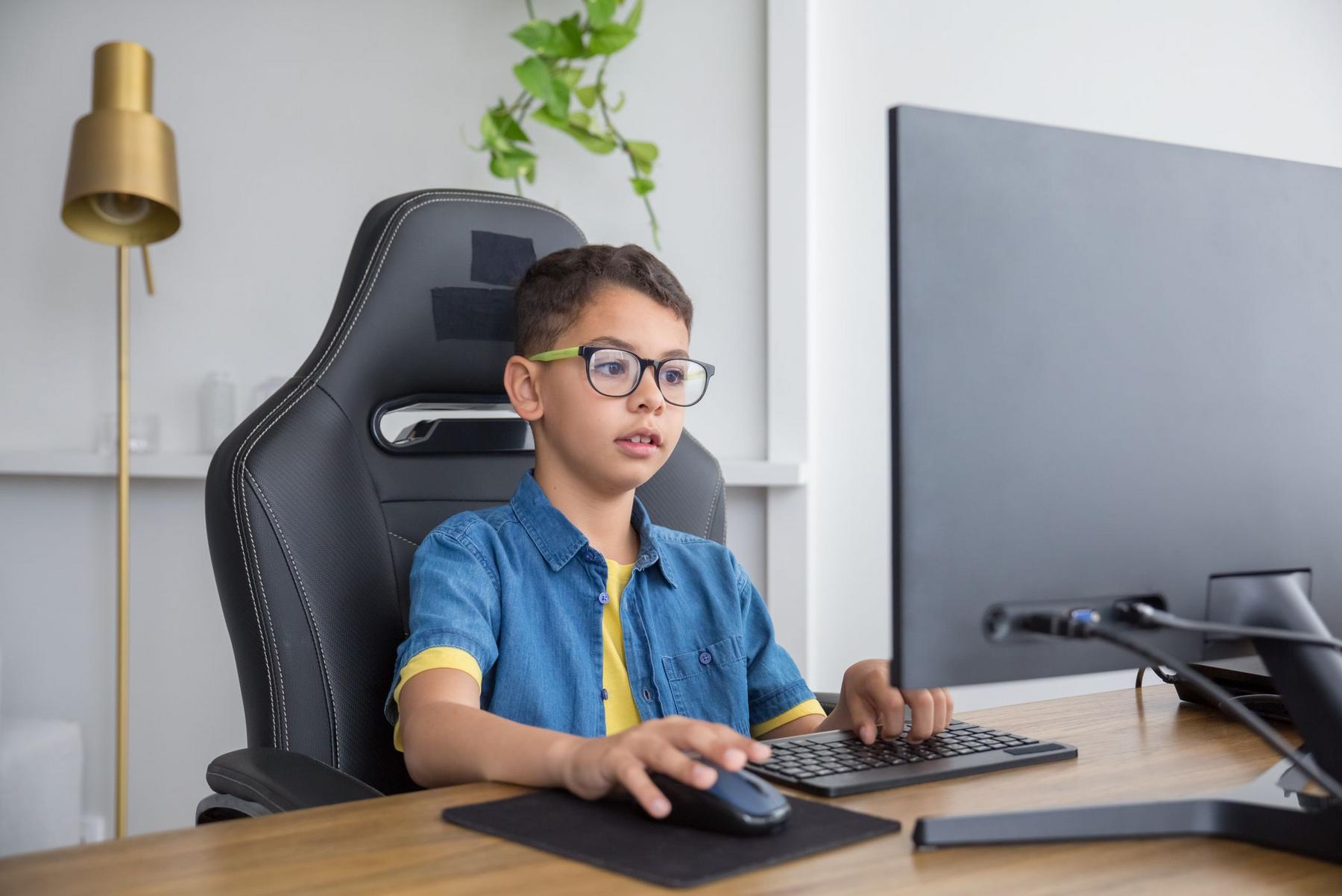
For computer-based work at a desk, the following general positioning guidance applies:
Monitor Positioning
The top of the screen should be at or just below eye level, at approximately one arm’s length away (around 50–100 cm). This supports a slight, natural downward gaze of 10–20 degrees – consistent with the eye’s natural resting position.
Keyboard and Mouse Positioning
Positioned at elbow level or just below, with wrists straight and the keyboard centred directly in front of the student. Both the keyboard and mouse should be kept close to the body to minimise reaching and shoulder tension.
Laptops
Ideally, a separate keyboard and mouse should be used with a laptop stand so the screen can be raised to the appropriate height independently of the keyboard position.
The 20-20-20 rule is also a helpful habit to establish: every 20 minutes of screen use, look at something approximately 6 metres away for 20 seconds. This simple practice reduces eye strain and naturally prompts a postural reset.
How Often Should Primary Students Take Movement Breaks From Their Desk?
Regular movement breaks are among the most effective strategies for reducing musculoskeletal discomfort and sustaining concentration in primary students. The Australian Government recommends changing posture every 20–30 minutes of sitting, followed by 2–3 minutes of movement.
Research on structured movement breaks in classrooms demonstrates compelling benefits: improved on-task behaviour, stronger concentration, and reduced likelihood of musculoskeletal discomfort across multiple body regions. Studies involving standing desk use in school settings have shown reductions in reported neck, shoulder, elbow, and lower back discomfort, alongside increases in daily physical activity.
A practical movement break structure for primary students might incorporate the following components:
Warm-Up Joint Activities (approximately 2 minutes)
Gentle circles and flexion-extension movements of the neck, shoulders, wrists, knees, and ankles to release areas under sustained tension.
Dynamic Stretching (approximately 1.5 minutes)
Upper limb, lateral trunk, and calf stretches targeting muscles that commonly tighten during prolonged seated work.
Rhythmic Movement (approximately 1 minute)
In-place stepping, marching, or jumping jacks to refresh circulation, energy, and focus.
Brief Interactive Activity (approximately 30 seconds)
Simple group or partner interactions that re-engage attention and social participation before returning to work.
Teachers and parents are encouraged to use timers or classroom routines to prompt these breaks consistently. Children who build the habit of moving regularly throughout their day are actively supporting both their physical health and their capacity to learn.
How Can Occupational Therapy Support Better Desk Ergonomics for Primary Students?
Occupational therapy plays a meaningful role in supporting desk set-up ergonomics for primary students – particularly for children with additional needs, developmental considerations, or persistent postural concerns. Occupational therapists take a whole-person, individualised approach to assessing how a child interacts with their physical environment, including their desk and classroom set-up.
An occupational therapy assessment in this context may include:
Individualised Measurement and Fit
Determining the child’s popliteal height, elbow rest height, and thigh length to establish furniture sizing recommendations that are specific to that individual child.
Postural Assessment
Observing the child’s sitting patterns, identifying habitual postures, and noting any areas of concern in how they move and position themselves.
Practical Modification Recommendations
Suggesting adjustments such as slanted writing surfaces (which encourage upright posture and improved wrist positioning), footrests, wedge cushions, chairs with armrests, or cut-out desks for additional trunk support.
Home and School Coordination
Ensuring ergonomic principles are applied consistently across both settings – particularly important given that children may spend several additional hours on homework and screen-based activities at home each day.
Education and Empowerment
Supporting children, families, and teachers to understand why good posture matters and equipping them with simple, practical strategies – such as the 90/90/90 self-check – to apply independently.
Desk set-up ergonomics for primary students is not a one-time adjustment. As children grow through the primary years, their furniture needs change alongside them, and their habits around sitting, screen use, and movement continue to evolve. Periodic reassessment helps ensure that a child’s physical environment keeps pace with their development.
Small Adjustments, Lasting Impact
The primary school years are a genuine window of opportunity. Postural habits – good or poor – established during this time tend to persist. When children are supported to understand what a well-fitted workspace feels like, to recognise their own posture, and to value regular movement throughout the day, they carry those habits far beyond the classroom.
Desk set-up ergonomics for primary students does not require expensive furniture or complex solutions. A well-positioned footrest, a correctly adjusted chair, a monitor raised to eye level, and a consistent movement break routine can collectively make a meaningful and lasting difference to a child’s physical comfort, concentration, and overall school experience.
Families, teachers, and health professionals each have a part to play – and the earlier these foundations are established, the better. If you have any concerns about your child’s posture, comfort at their desk, or movement patterns, consider speaking with your child’s school, your general practitioner, or a qualified allied health professional such as an occupational therapist for individualised advice.
What is the correct desk height for a primary school student?
Desk height is guided by the child’s elbow rest height and should be set so that when seated properly, the desk surface sits at or just 2–3 cm below the child’s elbow level. Typically, this means around 42 cm for children aged 5–8 years and 49 cm for those aged 9–12 years, though individual requirements may vary.
How do I know if my child’s chair is the right size for them?
A properly sized chair allows the child to have their feet flat on the floor (or on a footrest), maintain knees at roughly a 90 degree angle with a 2–3 cm gap between the seat and their knees, and ensure that their back is fully supported by the backrest with the natural lumbar curve maintained.
How often should primary school students take breaks from sitting at their desk?
Primary students should change their posture every 20–30 minutes, followed by 2–3 minutes of movement. Regular, structured breaks involving stretching and light physical activity can help reduce discomfort and improve concentration.
What is forward head posture, and how does correct desk set-up help reduce it?
Forward head posture occurs when the head shifts forward relative to the shoulders, placing extra load on the neck. A correct desk set-up—with a monitor at eye level, proper chair and desk alignment, and regular posture checks—helps reduce this abnormality and minimizes additional strain on the cervical spine.
When should I consider an occupational therapy assessment for my child’s desk ergonomics?
An occupational therapy assessment should be considered if your child experiences regular discomfort, shows signs of poor posture, has special developmental needs, or if you are uncertain about effectively setting up their workstation for optimal comfort and support.