When the Lights Seem Dimmer but Nothing Has Changed
There is a particular kind of frustration that comes with realising your home – a space you have navigated confidently for years – has quietly become harder to move through. Shadows on the staircase feel deeper. The kitchen bench is harder to work at after sunset. Reading the newspaper in your favourite chair requires more effort than it used to.
For many Australians, these experiences are not a matter of poor lighting choices. They are the result of real, measurable changes in how the eyes process light, contrast, and detail as we age or live with a disability. An estimated 575,000 Australians are living with blindness or vision impairment, with more than 70% of those individuals aged over 65. And yet the connection between vision changes, home lighting, and day-to-day independence is still widely underestimated.
Occupational therapists (OTs) are trained to assess this connection and recommend practical, personalised adjustments that can meaningfully improve safety and quality of life. Understanding what those adjustments involve – and why they matter – is a valuable first step.
How Do Age-Related Vision Changes Affect Day-to-Day Life at Home?
Vision does not decline in a single, uniform way. Different conditions affect different aspects of how a person sees, and each presents distinct challenges in the home environment.
Presbyopia is the most common cause of near visual impairment in older adults, accounting for 71.8% of near vision difficulties in some populations. Beginning in the early 40s, this condition causes the eye’s lens to lose flexibility, making it progressively harder to focus on close objects. By age 65, the lens has lost nearly all of its flexibility. Tasks such as reading medication labels, preparing meals, or reviewing documents require significantly more light than they once did.
Age-related macular degeneration (AMD) is the leading cause of blindness and significant vision loss in Australians over 50. It affects central vision – the detail-focused area needed for reading, recognising faces, and working in the kitchen – while typically leaving peripheral vision intact. Up to 68% of aged care residents in some studies showed signs of AMD, yet vision disorders were identified as the primary health condition in only 4.8% of admissions, highlighting how often these changes go unrecognised.
Cataracts cause the eye’s lens to cloud progressively, producing blurred or hazy vision and increased sensitivity to glare. They are significantly associated with elevated risks of falls, fractures, depression, and cognitive changes in older adults.
Beyond these specific conditions, general age-related changes affect the ageing eye across the board. Pupil size decreases, making it harder for the eyes to adapt when moving between light and dark spaces. Contrast sensitivity reduces, making edges, steps, and objects harder to distinguish from their backgrounds. Glare sensitivity increases. Altogether, these changes mean that by age 60, a person generally needs approximately three times more light than they did in their twenties – and when a sight loss condition is present, that figure can double again.
Why Does Home Lighting Matter So Much When Vision Changes?
Lighting is one of the most powerful and modifiable factors in a person’s home environment. When lighting is inadequate or poorly designed, the consequences for people with vision changes extend well beyond inconvenience. Vision impairment approximately doubles the risk of falls in older adults – and falls are among the most serious causes of injury and hospitalisation in this population.
People with vision loss enter residential aged care an average of three years earlier than those without vision impairment, and up to half of all aged care residents fall at least once per year. The relationship between poor lighting, vision changes, and fall risk is well-established in the research literature.
Research also demonstrates that vision loss can reduce social independence and significantly increase the risk of depression. A home environment that is difficult to navigate safely is not just a physical risk – it is a barrier to confidence, autonomy, and meaningful participation in daily life.
The good news is that targeted home lighting adjustments, delivered through a structured occupational therapy assessment, can meaningfully improve functional performance. Studies using the Canadian Occupational Performance Measure (COPM) have shown that lighting interventions improve outcomes across all measured activities. Colour discrimination, near-task performance, and overall comfort and well-being all show measurable improvement with appropriate lighting modifications.
What Does an OT Assessment for Vision and Home Lighting Involve?
Occupational therapists approach home lighting assessment with a structured, evidence-based framework. The assessment is not simply a matter of recommending brighter bulbs – it is a comprehensive evaluation of how a person’s visual function interacts with their specific home environment and the activities most important to them.
A thorough OT home lighting assessment typically includes evaluation of visual function using tools such as:
Distance and Near Visual Acuity Testing
Assessed using standardised charts to understand how clearly a person can see at varying distances, tested with current corrective lenses in good lighting conditions.
Contrast Sensitivity Assessment
Evaluated using tools such as the Mars Letter Contrast Sensitivity Test or Pelli-Robson charts, as well as functional tasks such as identifying white items on white surfaces.
Central and Peripheral Visual Field Evaluation
Including use of the Amsler grid for macular degeneration screening and confrontation field testing.
Objective Environmental Lighting Measurement
Using a light meter to measure illuminance (in lux) at key task locations – where the person reads, pays bills, and prepares meals – and documenting glare sources throughout the home.
One structured tool particularly relevant to this work is the Home Environment Lighting Assessment (HELA), developed specifically to evaluate home lighting in relation to near-task performance in older adults with low vision. The HELA demonstrates strong interrater reliability (ICC = .83–1.0) and provides a systematic framework for planning individualised lighting interventions.
The assessment also considers seating arrangement, positioning of reading materials, the appropriateness of existing optical aids, and the client’s own goals – whether that is reading comfortably, cooking safely, or moving through the home at night without anxiety.
Which Home Lighting Adjustments Do Occupational Therapists Recommend?
Lighting recommendations are highly individualised, but several evidence-based principles guide OT interventions for vision changes across home environments.
The appropriate level of lighting varies considerably depending on a person’s age, specific vision condition, home layout, and the activities they need to perform. Because these factors interact in ways that are unique to each individual, a personalised assessment by an occupational therapist is the most reliable way to determine what adjustments are needed in a particular home. An OT can objectively measure light levels at key task locations, identify areas of concern, and recommend modifications tailored to the person’s goals and circumstances.
Ambient Lighting Upgrades
Multiple light sources distributed across a room provide far more even illumination than a single overhead fixture. Uplighters that bounce light off ceilings minimise direct glare and soften shadows. Fluorescent tube fittings produce consistent, even light without the bright-and-dark patches created by spotlights. Where possible, dimmer switches allow light levels to be adjusted throughout the day as natural light changes.
Task Lighting
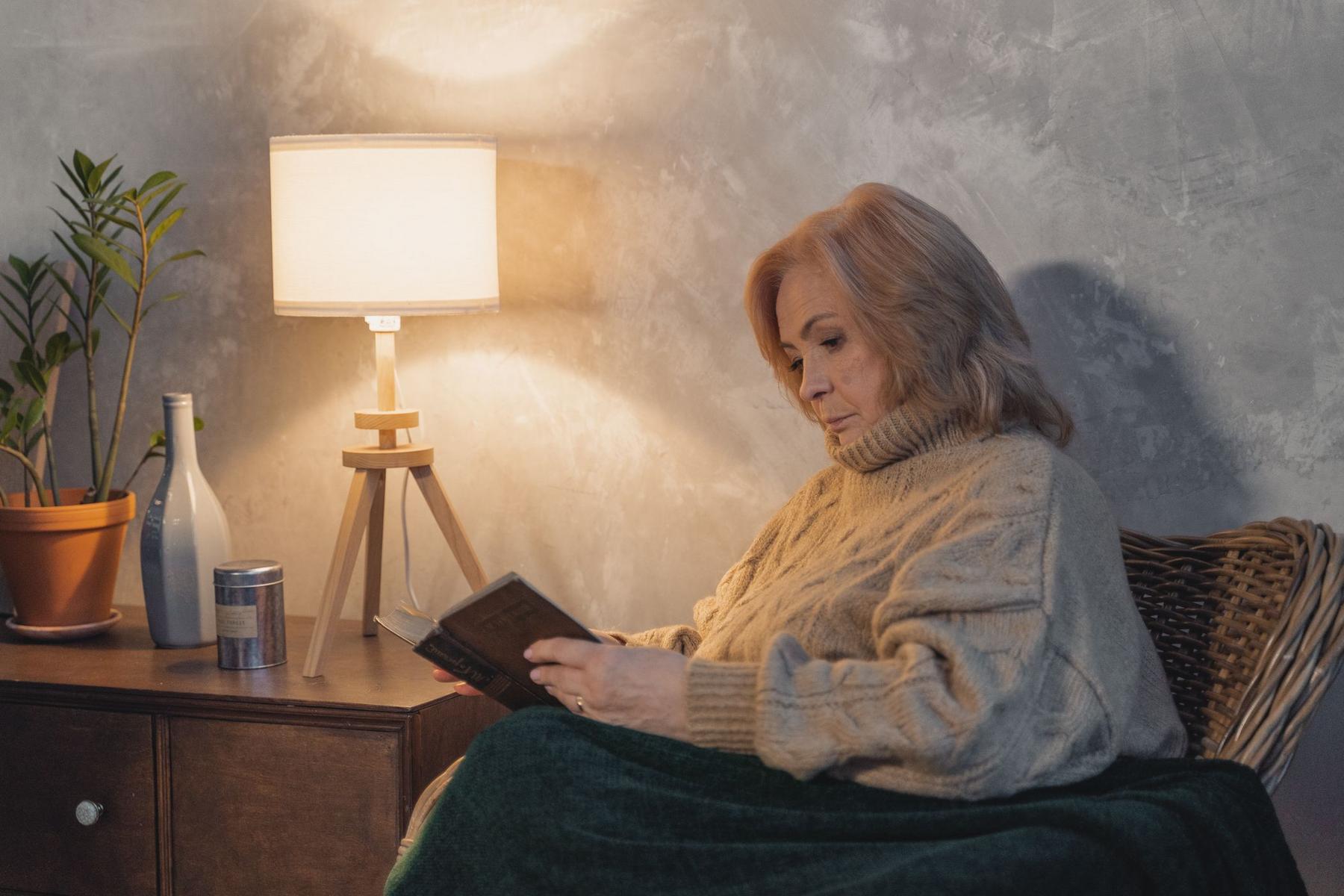
Adjustable, flexible-arm task lamps directed at the working surface – not into the eyes – are highly effective for activities such as reading, writing, and meal preparation. A practical principle from the physics of light applies here: halving the distance between a light source and an object produces four times the illumination. Positioning task lamps close to the work surface can therefore make a significant difference with no additional cost.
For right-handed individuals, a task lamp positioned to the left and slightly forward reduces hand shadows on work. For left-handed individuals, the light belongs on the right side. Under-cabinet lighting in kitchens is particularly effective for food preparation surfaces.
Glare Management
Glare is a significant issue for people with many common vision conditions. Management strategies include:
Lampshade and Diffuser Selection
Round paper shades and diffusers prevent direct view of the bulb and soften light output.
Window Treatment
Vertical blinds offer better light direction control than horizontal ones. Roller blinds help manage direct sunlight, while keeping windows clean and removing net curtains maximises natural daylight.
Surface Finishes
Matte or eggshell paint finishes on walls, and non-glare finishes on floor coverings and countertops, significantly reduce reflected glare throughout the home.
Motion Sensor Lighting
In hallways and bathrooms, motion-activated lighting provides automatic, appropriate illumination during nighttime movement without requiring the person to locate a switch in the dark.
Bulb Selection
LED lighting offers instant, crisp brightness, long life, and energy efficiency. For colour temperature, warmer tones (2,700K–3,000K) suit bedrooms and living spaces, while neutral to cool tones (3,000K–3,500K) are more appropriate for kitchens, bathrooms, and task areas. A Colour Rendering Index (CRI) of 80 or above is recommended as a minimum to ensure colours appear vivid and support visual acuity, with 90+ preferred where possible.
How Does Contrast and Colour Enhance Safety for People With Low Vision?
Lighting improvements work best when combined with strategic use of colour and contrast throughout the home. Reduced contrast sensitivity – common in AMD, glaucoma, diabetic retinopathy, and other conditions – directly affects a person’s ability to identify surfaces, boundaries, and objects.
Several practical contrast applications are evidence-based and widely used in OT home modifications:
Stairs and Flooring
Brightly coloured contrasting tape applied to stair edges is one of the most effective safety modifications available. At least 75mm in width, this tape creates a clear visual boundary at each step. Floors benefit from a mid-range Light Reflectance Value (LRV) of 30–50, while walls and ceilings should use lighter tones (LRV 60–80) to create layered contrast.
Kitchens
Reversible black-and-white cutting boards allow the user to select the background that best contrasts with the food being prepared. Appliance controls can be marked with brightly coloured raised dots or contrasting tape at frequently used settings. Solid-coloured dishware avoids the visual confusion of patterns.
Bathrooms
Contrasting-coloured toilet seats, bath mats, and towels help individuals with low vision orientate safely in a high-risk room. Contrasting tape applied along the full edge of the bathtub provides a consistent visual reference. Lighting in the bathroom should ideally be positioned on both sides of the mirror at eye level to eliminate facial shadows.
Throughout the Home
Light switches that contrast clearly with wall colour, door frames highlighted in bold contrasting paint, and contrasting door handles all contribute to a home that is easier and safer to navigate with changing vision.
Who Can Access OT Home Lighting Assessments Across Queensland, NSW, Victoria, and Tasmania?
Occupational therapy home lighting assessments and modifications are available to a broad range of Australians, including NDIS participants, aged care recipients, and private clients. As of June 2023, 10,158 active NDIS participants hold a primary disability of visual impairment – a figure that has been growing year on year. Eligible participants may access home modification supports, assistive technology recommendations, and capacity-building OT services as part of their NDIS plan.
For older Australians, OT supports accessed through aged care pathways can also include home environment assessments addressing lighting and safety. Given that people with vision loss enter residential aged care an average of three years earlier than those without, early assessment and intervention in the home setting represents a meaningful opportunity to support ageing in place.
Astrad Allied Health provides mobile occupational therapy services across Brisbane, North Lakes, and surrounding areas; the Gold Coast; Sunshine Coast including Peregian Springs, Noosa, Buderim, and Gympie; as well as Sydney and Melbourne. Telehealth services extend across Queensland, New South Wales, Victoria, and Tasmania – enabling Australians in regional and remote areas to access occupational therapy support for vision changes and home lighting.
Making a Home Work for Every Stage of Vision
Vision changes do not have to mean withdrawal from the activities and spaces that matter most. The evidence is clear: thoughtfully designed home lighting, combined with targeted contrast modifications and an individualised OT approach, can meaningfully restore confidence, reduce fall risk, and support genuine independence.
A home that is well-lit, appropriately contrasted, and assessed by a trained occupational therapist is not a compromise – it is a home designed to work harder for the person living in it. For Australians navigating vision changes at any age, occupational therapy home assessments represent one of the most practical and evidence-informed steps available.
Have questions? Need help? Contact Astrad Occupational Therapy today.
What is an OT home lighting assessment and what does it involve?
An OT home lighting assessment is a structured evaluation conducted by an occupational therapist to measure how well a home’s lighting environment supports the functional needs of someone experiencing vision changes. The assessment typically involves objective measurement of light levels at key task locations, identification of glare sources, evaluation of contrast within the environment, and a review of the person’s ability to carry out daily activities safely. It is tailored to the individual’s specific vision condition, home layout, and personal goals.
Can NDIS funding be used for home lighting modifications recommended by an OT?
NDIS participants may be able to access occupational therapy assessments and associated home modification supports through their plan, depending on their funded supports and individual goals. An OT can conduct the assessment and provide recommendations that may support a request for funding. It is advisable to speak with your plan manager or support coordinator to understand what may be applicable to your specific plan. This article does not constitute financial advice.
How much brighter does my home need to be if I have a vision condition?
General research guidance suggests that by age 60, a person requires approximately three times more light than in their twenties. When a sight loss condition is also present, that requirement can double. However, individual needs vary considerably depending on the specific vision condition, home layout, and the activities most important to the person. A personalised assessment by an occupational therapist – using a light meter to objectively measure illumination at key task locations – is the most reliable way to determine what adjustments are needed in your particular home.
Are these OT home assessments available in regional Queensland and other states?
Yes. Mobile OT services are available across metropolitan and many regional areas of Queensland, New South Wales, Victoria, and Tasmania. Telehealth OT services extend across Queensland, Victoria, New South Wales, and Tasmania, enabling clients in areas not easily reached by mobile services to access professional guidance on home lighting adjustments and vision-related modifications.
What is the difference between ambient lighting and task lighting, and why does it matter for vision changes?
Ambient lighting provides the general level of illumination across a room, reducing shadows and supporting safe movement. Task lighting is directed, adjustable light positioned close to a specific work surface—such as a reading lamp or under-cabinet kitchen light—providing high levels of illumination exactly where detailed activity occurs. For people with vision changes, both are important: ambient lighting creates a safe baseline, while task lighting significantly boosts visibility for close work without creating the glare or fatigue that comes from a single overly bright general light source.