Selective mutism is an anxiety-related condition in which a child speaks comfortably in some places, usually at home, but consistently cannot speak in others, such as school. It is not shyness, stubbornness or rudeness.
Many families first hear the term from a kindy teacher or a prep teacher who has never heard their child’s voice. That moment can be confusing, because the child you know at home chats, sings and argues like any other. This article explains what clinicians look for, why the silence happens, what approaches clinicians describe, and how families in Australia can find support.
What selective mutism looks like day to day
Clinicians use the criteria in the DSM-5-TR, the diagnostic manual published by the American Psychiatric Association (American Psychiatric Association, 2022). A child consistently does not speak in specific social situations where speaking is expected, while speaking normally in other situations. For a diagnosis, the pattern also has to interfere with schooling or social communication and last at least one month, not counting a child’s first month of school. It cannot be explained by a lack of knowledge of, or comfort with, the language being spoken. It cannot be better explained by a communication disorder, and it cannot occur only during autism or a psychotic disorder.
The home picture is rarely all-or-nothing. A child may talk freely with parents and siblings but go quiet with grandparents or cousins, or fall silent with their own family the moment a visitor walks in.
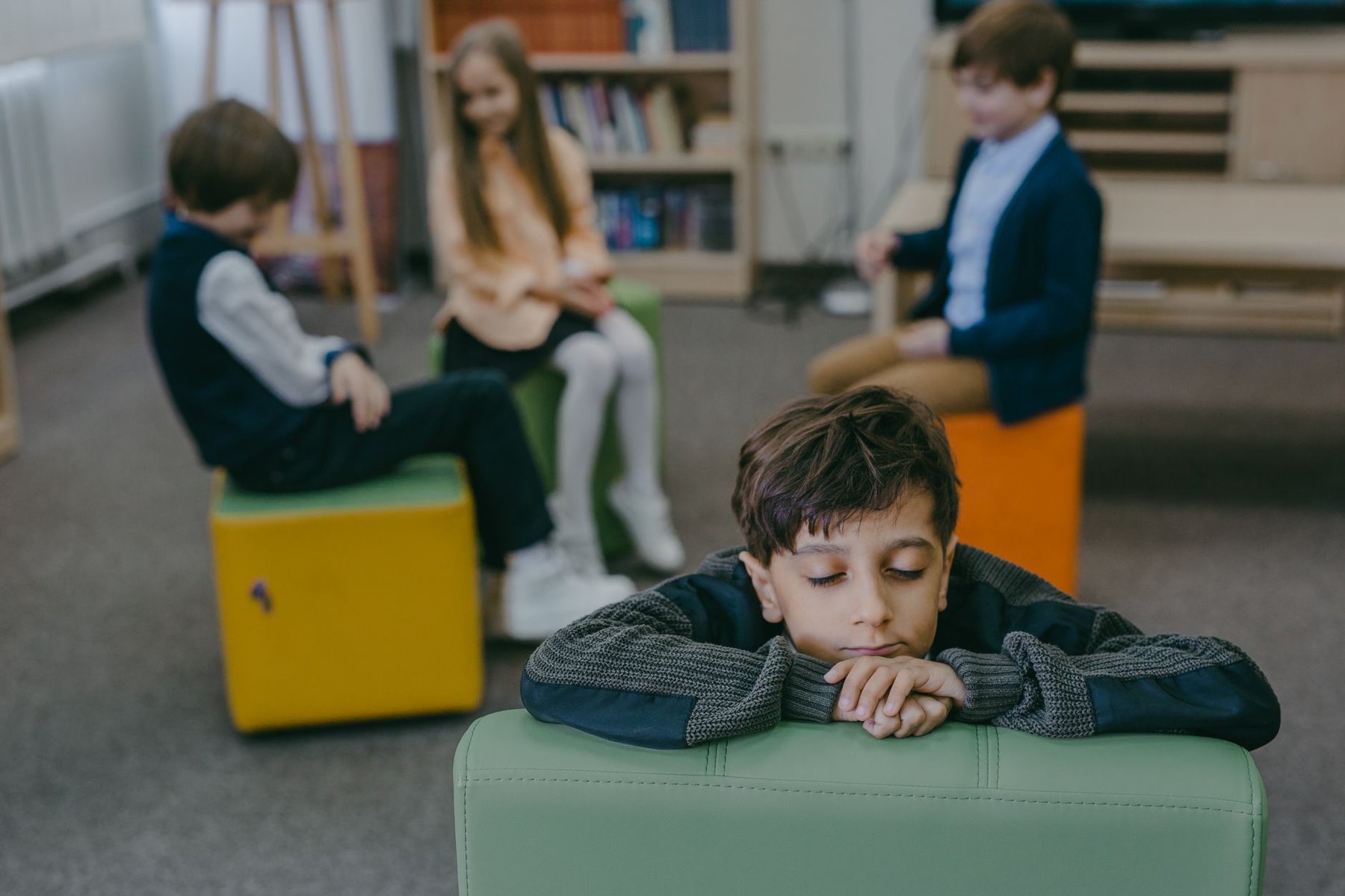
At school or in the community, the signs look different. The child may appear frozen, with a blank facial expression and little eye contact. Some children nod, point or whisper to one trusted friend. Others cannot do even that. Teachers sometimes read this as defiance or disinterest, and that misreading is one of the main reasons support arrives late.
Silence is a fear response, not a decision
The word “selective” causes more harm than any other part of the name. Despite the name, children with selective mutism do not choose where to speak. The child is more comfortable speaking in some settings than others. In the hard settings, anxiety triggers something closer to a freeze response. The behaviours that follow protect the child in the moment, yet adults frequently interpret them as difficult behaviour.
Anxiety sits at the centre for most children. Many children with selective mutism also have at least one other anxiety disorder, with social anxiety disorder especially common.
The full picture is broader than anxiety alone. Researchers Christopher Kearney and Melanie Rede argue that the condition varies so much between children that “a more accurate conceptualization may be as a neurodevelopmental disorder” (Kearney and Rede, 2021). A 2025 UK preprint describes the causes as multifactorial, listing contributing factors such as family history of shyness or selective mutism, parental mental health, communication difficulties, developmental delay, autistic features and behavioural inhibition, a temperament that is cautious with new people and places (medRxiv, 2025).
Autism deserves a specific mention. In clinical samples, a substantial share of people with selective mutism are also autistic. Clinic samples tend to include more complex presentations, so that finding does not describe every child. It does make a strong case for assessment that looks at the whole child rather than the silence alone.
Why it so often surfaces at school
Onset usually falls between ages 3 and 6 (Viana et al., 2009). Diagnosis comes later, because a quiet preschooler at home raises few alarms. School changes that. Speaking is suddenly expected all day, in front of groups, with adults the child does not know well.
The gap can be long. In a group of autistic children with selective mutism, symptoms began at a mean age of 4.5 years, while diagnosis came at a mean of 8.8 years (Steffenburg et al., 2018). That is more than four years of a child struggling in classrooms without a name for it.
Prevalence estimates vary widely, from 0.03% to 1.9% of children, largely because studies sample children in different ways (Viana et al., 2009). The condition is uncommon, which partly explains why many educators have never encountered it.
Multilingual families need a careful assessment
Australia’s classrooms are linguistically diverse, and this is where assessment gets delicate. A preprint drawing on earlier studies reports early-years prevalence of about 0.7% overall and about 2.2% among children from immigrant backgrounds (medRxiv, 2025). At the same time, the diagnostic criteria exclude silence that comes from simply not yet knowing the language. Many children learning English go through a normal quiet period.
Telling these apart takes information about how the child speaks in every language they use, at home and elsewhere. A speech pathologist can help here by looking at language skills across languages, so that a child learning English is not mislabelled, and a child with genuine anxiety is not dismissed as “just learning English”.
Approaches clinicians describe
Clinicians describe behavioural approaches built around small, planned steps rather than pressure. The techniques have clinical names, but the ideas are simple:
Graded exposure means practising speaking in situations that move gradually from easy to hard. Stimulus fading means starting with someone the child already talks to, then slowly bringing a new person into the conversation. Shaping rewards small approximations of speech, such as making a sound, before full words. Modelling and reinforcement round out the approach. Practice is usually planned around the places where the silence occurs: home, school and the community.
Families sometimes ask about medication. Its use for selective mutism in children is off-label in Australia, and the trial base is thin: one frequently cited placebo-controlled study included just 15 children aged 6 to 11 (Black and Uhde, 1994). Any decision about medication belongs with the child’s doctor.
Waiting for a child to grow out of selective mutism is a plan built on hope. Talking with a qualified professional early gives families clearer information about their options.
Telehealth: what the evidence does and does not support
We think families deserve a straight answer on this. Published research on online formats for selective mutism has largely looked at self-guided web programs (Iimura et al., 2025).
Live sessions with a psychologist over video are a different thing from a self-paced online course, yet research specific to clinician-led telehealth for selective mutism remains limited. Our view: telehealth can suit conversations with parents and teachers, planning and check-ins, alongside time in the child’s real settings. For families outside mobile areas, that combination can make access to a clinician possible where it otherwise would not be.
Teens and adults
Selective mutism does not belong only to young children. A 2026 review of people aged 10-24 found only 40 studies covering 54 people (de Jong et al., 2026). The authors judged the evidence weak and mixed. The clearest message from that review is that adolescents need age-appropriate approaches. Child protocols copied across without adjustment do not fit a teenager’s social world.
How psychology, speech pathology and occupational therapy share the work
Selective mutism sits across several disciplines, and the best-coordinated support draws on each one for what it does well.
| Discipline | Main focus | What this can include |
|---|---|---|
| Psychology | Anxiety and avoidance | Assessment, parent guidance, school liaison |
| Speech pathology | Communication skills and access | Ruling out speech or language difficulties, building social communication confidence, AAC such as cards or devices, parent coaching, school liaison |
| Occupational therapy | Regulation and participation | Supporting participation in class, play and community routines |
AAC (augmentative and alternative communication) can worry parents, who fear it will replace speech. Used well, it gives a child a way to communicate needs while speaking feels impossible.
Location matters as much as discipline. Because much of this work centres on everyday settings, some families find a mobile service that can visit the home, school and community practical. Astrad offers occupational therapy, speech pathology and psychology under one provider. Our mobile psychology runs on the Gold Coast, with telehealth psychology available Australia-wide, and our occupational therapists and speech pathologists visit homes, schools and communities across our service areas, with telehealth across most of Queensland, New South Wales, Victoria and Tasmania.
Finding support in Australia
Professional advice is worth seeking when a child’s silence persists or affects learning or friendships. The usual pathway looks like this:
- Start with your GP or paediatrician. They can check for other explanations, such as hearing problems, and discuss referrals to a psychologist or speech pathologist.
- Ask about Medicare support. A GP can prepare a Mental Health Treatment Plan under the Better Access initiative, which provides Medicare rebates for some psychology sessions. Session numbers and rules change, so confirm the current details with your GP.
- Check NDIS options if relevant. NDIS access depends on functional impact, not on a diagnosis alone, and funding decisions rest with the NDIA. Astrad is not a registered NDIS provider, so participants who are plan-managed or self-managed can use their funding with us. Agency-managed plans cannot be used.
- Bring the school in early. Teachers who understand the condition can stop pressuring the child to talk and start supporting planned steps instead.
Private clients can contact allied health services directly without a referral, although a GP visit remains a sensible first step for ruling out other causes.
Everyday communication at home and school
Daily life offers plenty of chances for low-pressure communication. Some general ideas families often find useful:
- Take the spotlight off speaking. Comments and relaxed shared activities tend to create less pressure than direct questions in front of others.
- Wait calmly after a question. Giving a few seconds of quiet time, rather than answering for the child straight away, leaves room for a response without demanding one.
- Praise brave communication specifically and quietly. A calm “I liked hearing your answer” tends to land better than a big public fuss.
- Preview new places. Visiting a classroom or activity when it is quiet, before the busy first day, can make the setting feel less threatening.
- Watch the labels. Describing a child as “the shy one” or “the one who doesn’t talk” in their hearing can reinforce the role.
Every child’s plan looks different, and the right next step depends on where your child is starting from. Questions about your own child are best taken to a qualified health professional who can assess them in person.
If you have questions about selective mutism or how mobile therapy could fit your family’s routines, we are happy to talk it through. Call us on 0468 552 997, email [email protected], or get in touch through the contact page on our website.
How is selective mutism different from being a late talker?
A late talker has limited speech or language skills in every setting, including at home. A child with selective mutism usually speaks well in comfortable places but cannot speak in others. Some children have both, which is why a speech pathology assessment can be useful. A qualified professional can look at language skills alongside the setting-specific pattern before drawing conclusions.
How can a school adjust oral tasks for a child with selective mutism?
Schools commonly use alternatives while a child builds confidence, such as written answers, recorded responses made at home, pointing or cards, or presenting to one trusted adult instead of the whole class. The aim is to keep the child learning and assessed fairly while gradual speaking steps continue. Adjustments work best when the school and therapist agree on them together.
Can an adult be assessed for selective mutism for the first time?
Yes. Some people reach adulthood without ever being assessed, particularly if their difficulties were seen as shyness at school. Adults can speak with their GP about a referral to a psychologist, and a speech pathologist can help where communication confidence or alternative communication methods are part of the picture. Support is planned around adult work, study and social settings.