Integrating social play for communication development means using everyday games, shared routines and play with other people as the main place a child practises communicating. Turn-taking, joint attention, copying and negotiating all happen naturally in play. When parents and therapists follow a child’s lead during play, each game creates more chances for the child to practise communicating.
Play is the one activity children choose freely, which is exactly why it works as a setting for communication. A child who is having fun has a reason to ask for more, protest, comment and share. The rest of this guide explains how that happens, what the evidence supports and where it falls short, and how play-based speech pathology and occupational therapy fit with the NDIS and the new Thriving Kids program in 2026.
Why play is where children practise talking
Children don’t learn to communicate because adults ask them questions. They learn because they want something: another push on the swing, the next bubble, a turn with the red car. Play supplies those reasons over and over. Each one is a chance to request, comment, refuse or share a joke, and each is a real exchange with a real person.
Play also holds the groundwork skills that come before spoken words. Joint attention is the clearest example. It means looking at the same thing as another person and knowing you are both looking. When a parent and toddler both watch a tower wobble and fall, they are sharing a moment, and that shared focus is where new words get attached to meaning. Imitation, listening and waiting for a turn sit right alongside it.
Turn-taking deserves its own mention because it starts long before a child can talk. Rolling a ball back and forth, peek-a-boo and pushing cars to each other all teach the rhythm of conversation: I go, you go, I go again. A child who has mastered that rhythm with a ball has already learned the structure that spoken conversation hangs on.
The national picture explains why families and educators are paying closer attention. In 2024, 8.9% of Australian children starting school were developmentally vulnerable in communication skills and general knowledge, a small rise since 2021 (AEDC, 2024). Across all developmental domains, 23.5% of school starters were vulnerable on at least one (AEDC, 2024). These are population figures, not predictions about any individual child, but they show that early communication support is a shared community concern rather than a niche one.
The stages of social play and what communication looks like at each
Sociologist Mildred Parten described six stages of children’s social play almost a century ago, and the framework still holds up as a practical lens (Parten, 1932). Treat the stages as patterns rather than strict age brackets. Children move back and forth between them depending on the setting, their temperament, how tired they are and how demanding the activity is. A confident four-year-old may play cooperatively at home and slip back to watching from the edge at a busy birthday party. That is normal.
| Stage | What it looks like | Communication opportunities |
|---|---|---|
| Unoccupied | Watching, moving around, exploring without a clear game | Noticing what catches the child’s eye; adults can name it |
| Solitary | Playing alone with toys, absorbed in own activity | Adults sit nearby and comment on the child’s play without directing it |
| Onlooker | Watching other children play, sometimes asking questions | Joint attention on others’ play; early questions and comments |
| Parallel | Playing beside another child with similar toys, little interaction | Copying actions and sounds; brief glances and shared moments |
| Associative | Playing with others, sharing materials, loosely organised | Requesting, offering, simple negotiation over toys |
| Cooperative | Shared goals, roles and rules, such as pretend play or games | Planning, storytelling, problem solving, longer conversations |
The value of the table is in the right-hand column. Each stage offers its own communication practice, and none is a failure state. Parallel play, for instance, can look like nothing much is happening, yet children copy each other’s sounds and actions constantly in it. For many children, that copying is the bridge to associative play.
What integrating social play for communication development looks like at home
The approach used in most parent coaching programs follows a simple cycle. Wait for the child to send a message, whether that is a look, a sound, a gesture or a word. Follow their lead by joining whatever they have chosen to play. Add something small and animated, like a sound effect or a single word. Then wait again. The cycle sounds almost too simple, and that is its strength: it fits into bath time, the car, the backyard and the supermarket.
Turn-taking games are the easiest entry point because the structure is built in. These games may suit many children, depending on their age and abilities:
- Rolling or bouncing a ball back and forth
- Peek-a-boo with a blanket or scarf
- Blowing bubbles and pausing before the next one
- Pushing cars or trains to each other along the floor
- Building a tower together, one block each
- Simple action songs with a pause where the child fills the gap
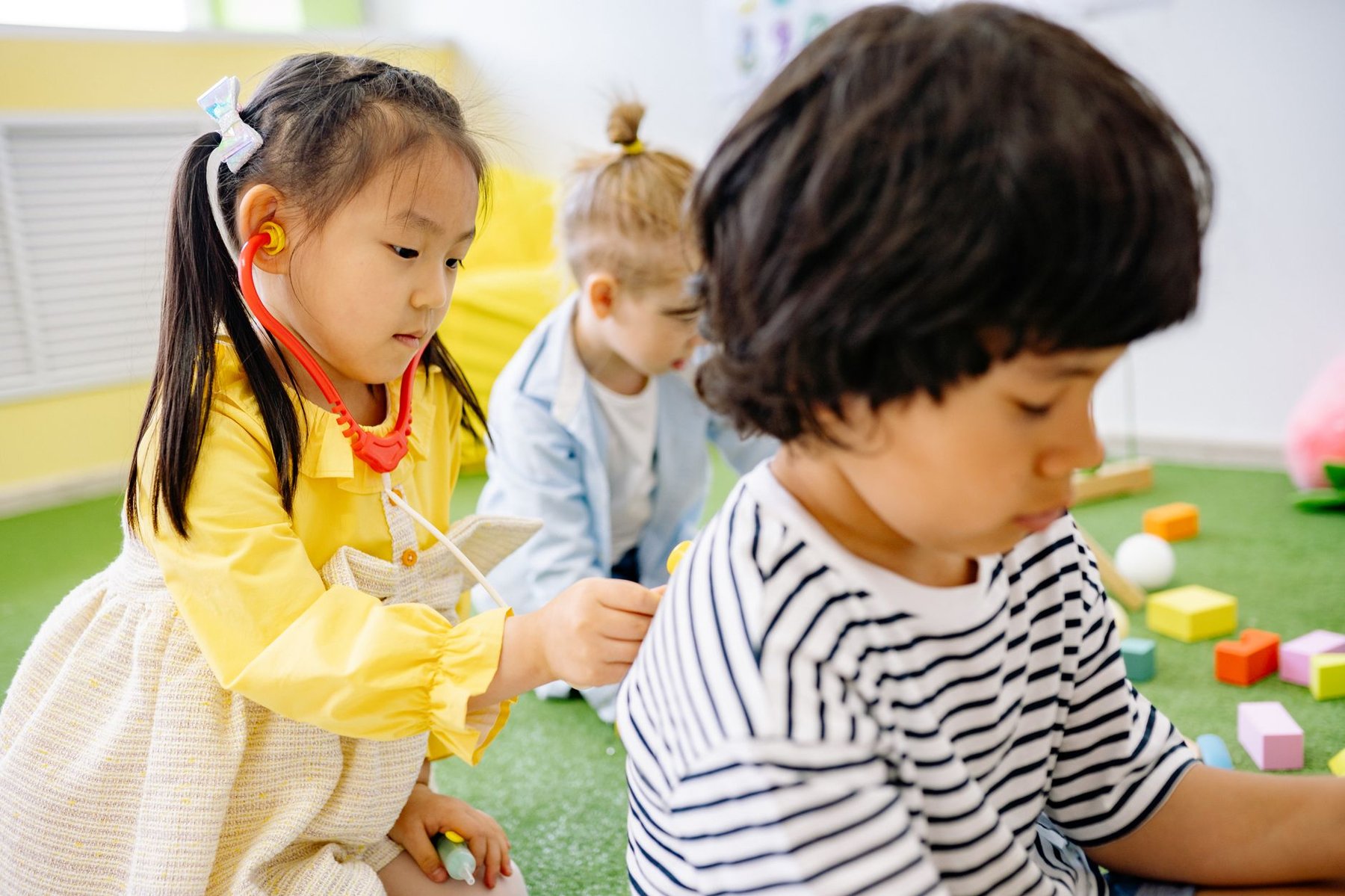
For older children, try simple board or card games, pretend play with roles such as shop, doctor or cafe, building challenges with a shared goal, and outdoor rule-based games like tiggy. These games ask children to negotiate, explain the rules and keep a conversation going.
The adult’s job inside these games is harder than it looks. Wait for the child’s turn instead of filling the silence. Keep your own turns short so the child gets more of them. Resist taking over when the tower leans. Slow down for children who need more time to process what has happened, because a pause of several seconds can feel very long to an adult and just right to a child.
The most useful thing an adult can bring to a child’s play is a pause.
Social play with other children adds a layer that adult play can’t. Peers are less predictable, they don’t always wait, and they want their turn too. That unpredictability is the practice. Short, structured playdates with one other child and a familiar activity tend to suit children who find groups overwhelming, while playgroups and childcare give children who are ready for it a wider audience.
These are general ideas, not a treatment plan. Every child communicates differently, and the right goals for your child depend on their strengths, interests and needs. A speech pathologist or occupational therapist who has met your child is the right person to tailor them.
Some signs are worth raising with a speech pathologist:
- Little joint attention or pointing by around 12-18 months
- Not taking turns in simple back-and-forth games
- Few words or word combinations for their age
- Often avoiding play with other people
- Losing words or skills they used to have
These are prompts for a conversation, not a diagnosis. Many children who show one of these signs are simply developing at their own pace, and a professional can help you work out whether support would help.
What the research supports, and where it is thinner
Research into play-based, parent-involved approaches is ongoing, and it deserves an honest reading. A 2024 review of 26 studies looked at parent-led, play-based approaches for children aged 0-6, in which parents are coached to join their child’s play and respond to their communication (Review Journal of Autism and Developmental Disorders, 2024). The same review found results varied widely from study to study, so no single figure tells the whole story.
A separate analysis of 32 randomised controlled trials examined training parents in naturalistic developmental behavioural interventions (NDBIs: play-based approaches that follow the child’s lead within everyday routines) (PubMed Central network meta-analysis, 2024). The authors noted that differences between specific methods weren’t consistently significant. Our reading is that the shared ingredients matter more than the brand name on the program.
A 2025 systematic review of eight trials looked at similar approaches and flagged uneven study quality (PubMed systematic review, 2025). The same year, a randomised trial of a low-intensity program called A-FFIP found it did no better than enhanced usual care for social communication after one year (A-FFIP randomised controlled trial, 2025). That result is a useful reminder that research in this area is still developing.
One more caution belongs here. Gains measured in the therapy setting don’t automatically show up at the playground, at kindy or at the dinner table. That is the strongest argument for therapy that happens in the places children actually play, and for coaching the adults who are there every day.
Australia’s National Guideline for supporting autistic children sets out 84 recommendations for children aged 0-12 (Autism CRC, 2022). It favours goals that are functional and meaningful to the child, relevant to where children live, learn and play, and supports that are safe, wanted and enjoyable, with families involved (Autism CRC, 2022). We think that framing is right for all children, not only autistic children. Social play shouldn’t be a drill with stickers at the end. A child who is enjoying the game is communicating because they want to, and that motivation is worth far more than compliance.
How speech pathology and occupational therapy work together in play
Communication rarely struggles on its own. A child who can’t stay regulated in a noisy room, can’t manage the fine motor demands of building a block tower, or finds the feel of play dough distressing will have fewer chances to practise talking during play. This is where speech pathology and occupational therapy overlap.
Our speech pathologists focus on the communication itself: joint attention, turn-taking, requesting, early words, combining words, and the conversation skills that cooperative play demands. Some children also use augmentative and alternative communication (AAC), such as picture boards or speech-generating devices, and play is one of the most natural places to practise using them. Our occupational therapists look at the sensory, motor and environmental side: how a child’s body and surroundings either support play or get in the way. When both disciplines work from the same picture of a child, families get one consistent set of goals instead of two competing ones.
Because our service is mobile, sessions happen in the child’s home, school, childcare centre or local park. That means therapists see the real toys, the real siblings and the real routines, and can coach parents and educators in the setting where the skills will be used. For families outside our mobile areas, telehealth may be an option for parent coaching. With the family’s permission, a therapist can review short videos of everyday play with parents, pointing out the moments when a child is communicating and how the adult can respond. Many parents find their child is sending more signals than they realised.
Thriving Kids, the NDIS and play-based supports in 2026
Thriving Kids launched on 1 October 2026 as the first major program of Thriving Kids foundational supports for children aged 0-8 with developmental delay or autism and low-to-moderate support needs (ABC News, 2026). Its first phase offers information, developmental guidance, help finding services and early support, with no diagnosis or referral needed. The Australian Government has committed $2 billion over five years to the program (Department of Health, 2026).
Play sits at the centre of how Thriving Kids will be delivered. Planned services include supported playgroups for under-fives, after-school and holiday groups, and individual or small-group play-based therapy, delivered at home, in early learning, at school and in community spaces (NSW Department of Communities and Justice, 2026). Full rollout is expected by 1 January 2028. From then, children aged 8 and under with low-to-moderate needs will be directed to Thriving Kids, while children with high support needs remain with the NDIS. Current NDIS participants keep their supports for now (ABC News, 2026).
For families using the NDIS today, it helps to be clear about how Astrad fits. We are not a registered NDIS provider, so NDIS participants access our speech pathology and occupational therapy through plan-managed or self-managed funding. Whether a particular support is funded depends on the participant’s plan and the NDIA’s decisions, and we can’t promise any funding outcome. Private clients can access our services directly, without NDIS involvement. If you’re unsure how the changes affect your child, your plan manager or support coordinator is a good first conversation, and we’re happy to explain what our play-based services involve so you can make an informed choice.
If you have questions about play-based speech pathology or occupational therapy for your child, at home, at school or by telehealth, we’re glad to talk them through. Call us on 0468 552 997, email [email protected] or get in touch through the contact page on our website.
Does screen-based play count as social play for communication?
Screens can be shared, but most apps and videos don’t respond to a child’s signals the way a person does, so there are fewer real turns. Watching or playing together and talking about what is happening adds back some of that back-and-forth. Interactive play with people, objects and routines gives the richest practice for joint attention and turn-taking. A speech pathologist can talk through screen use in the context of your family.
Can bilingual families play in their home language?
Yes. Speech pathologists commonly encourage families to play and talk in the language they are most comfortable and expressive in, because warm, natural interaction matters more than which language is used. Children can learn more than one language through play. If you have questions about your child’s language development across two or more languages, a speech pathologist can assess and advise on your child’s individual situation.
How can brothers and sisters be involved in social play?
Siblings are often a child’s most frequent play partners, which makes them a natural part of the picture. Simple shared games with clear turns, such as rolling a ball or building together, can suit siblings of different ages. Older siblings can model sounds and actions. During mobile sessions at home, therapists can include siblings so the strategies fit how the family actually plays together day to day.
What happens at a first play-based speech pathology session at home?
A first session usually involves getting to know the child and family, talking about the child’s interests, routines and communication, and observing play in a relaxed way. The therapist may ask about history, goals and any concerns. There is no need to prepare special toys, because the child’s own toys and spaces are useful. Ongoing sessions and goals are then planned together with the family.