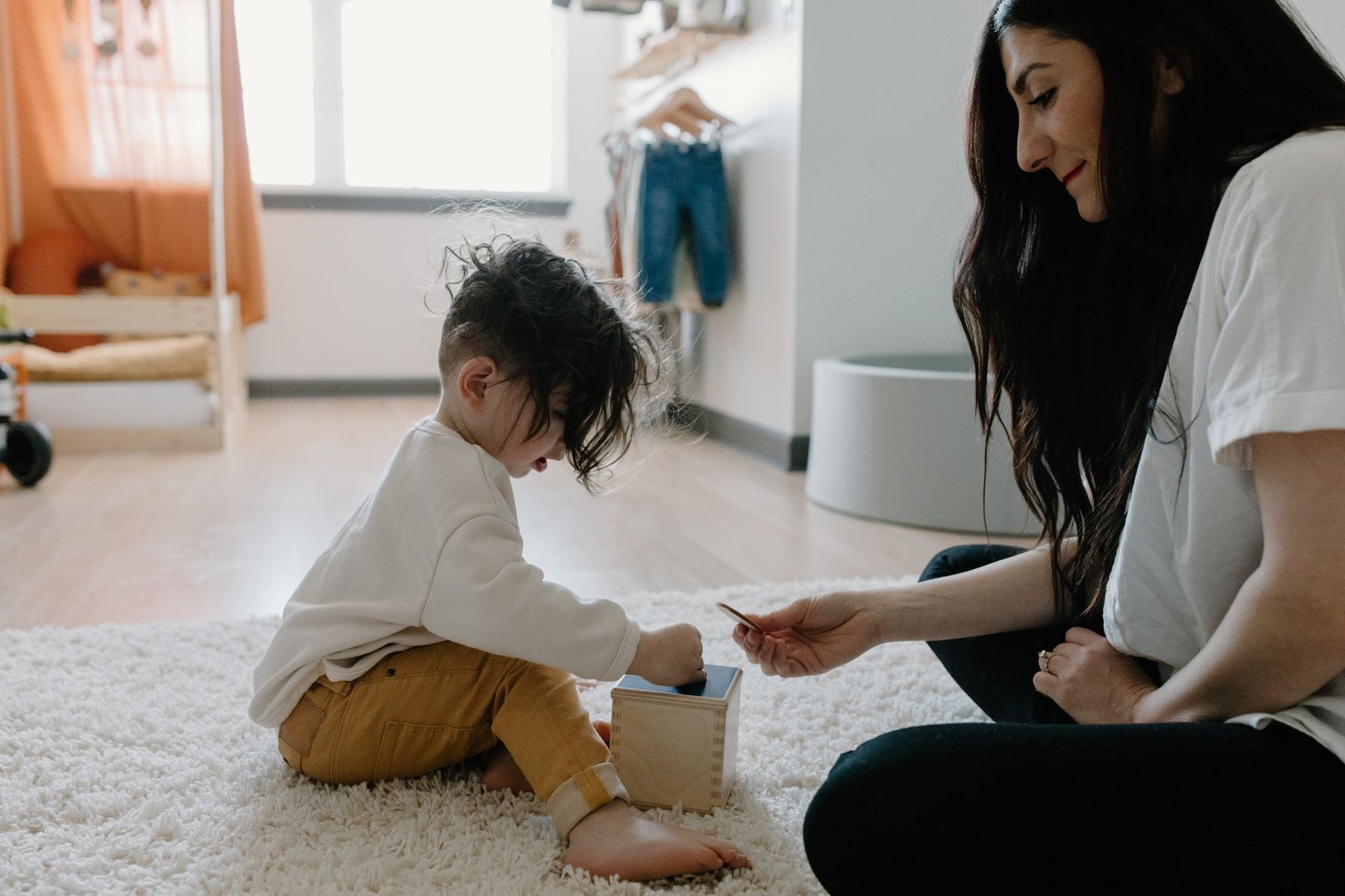
Parent involvement in play-based OT means parents and carers help choose the goals, take part in sessions and bring play strategies into everyday routines between appointments. Research suggests progress on the goals families care about may be stronger when therapy is built around the people and places in a child’s daily life, not just a weekly session.
The catch is that the strongest results come from small, consistent practice inside existing routines, not from extra homework.
A weekly session is a small slice of a child’s week
A therapy session might last an hour. The rest of the week is spent at home, at childcare or school, in the car, at the park and at the dinner table. That is where children actually use the skills therapy is working on: getting dressed, taking turns, holding a pencil, joining in a game with a sibling.
Occupational therapists call the movement of a skill from one setting to another generalisation. It does not happen by itself. A child who can thread beads at a therapy table may not use the same fine motor control to do up a button at 7.45 on a school morning. The adults around the child bridge that gap, because they are present in the moments that matter.
For this reason we treat the parent as a partner in the work and not as a spectator. It is also one reason our occupational therapists come to the family's home, school or community. Strategies learnt in the living room or the classroom are already in the place where they need to work, so there is less to translate.
What Australian guidance says about families in therapy
Australian policy is clear on this point. The National Best Practice Framework for Early Childhood Intervention says early childhood intervention should build the capability of parents, carers and families so they can give children experiences that support development and participation. It also says learning should happen in everyday settings to the maximum extent possible (Australian Government Department of Health, 2025).
NDIS early childhood guidance describes family-centred practice, where the whole family is treated as the client. Supports are shaped around the family’s strengths, priorities, routines and circumstances, and parents’ knowledge of their own child is treated as essential. The guidance also defines “natural settings” broadly. Home counts, and so do childcare, preschool, playgroups, community spaces and school. Coaching the adults around the child is the main method, partly so families do not come to depend on a therapist for every next step (NDIS, 2024).
OT Australia’s guide to working with children takes the same position, describing paediatric occupational therapy as person-focused and family-centred (OT Australia, 2016).
The newest development is Thriving Kids, a foundational supports program that sits outside the NDIS. It is for children aged 8 and under with developmental delay and/or autism and low-to-moderate support needs. General supports include parent skill-building, help finding services and peer connection. Targeted supports may include occupational therapy delivered at home, in the community or in education settings. National Cabinet agreed to up to $4 billion over five years, and initial state and territory services were due to begin from 1 October 2026, with full rollout by 1 January 2028 (Australian Government Department of Health, 2026). Children with permanent and significant disability remain eligible for the NDIS. Rollout differs from state to state, so check what is available where you live.
Across all of these documents, building family capability is the main aim, and policy treats it that way.
What research on parent involvement in play-based OT shows
The evidence is encouraging, and it has limits. Both are worth knowing.
Play is both the method and the goal
In play-based occupational therapy, play is the way therapy is delivered, and play skills are often a goal in their own right. Guided and/or free-play OT programs often focus on playfulness and social play in autistic children. In early intervention goal-setting, the goals parents choose are often about play, along with communication, behaviour and social interaction. When parents decide what matters, play comes up again and again.
Coaching parents has a growing evidence base
The best-known structured model is Occupational Performance Coaching (OPC). The therapist uses guided conversations to help a parent choose goals that matter to the family, work out what is getting in the way, come up with their own strategies and review how they went. Goals can be about the child, the parent or the whole family (JMIR Research Protocols, 2021). The parent does most of the thinking, and that is deliberate.
Research on coaching in occupational therapy has reported gains in occupational performance or goal attainment, and in some cases in parent self-efficacy, meaning parents’ belief that they can help their child. Two measurement tools were most common. The Canadian Occupational Performance Measure (COPM) was used in 28 studies and Goal Attainment Scaling (GAS) in 13.
In plain English, COPM asks families to rate how well their child performs goals the family has chosen, and how satisfied they are with that performance. A change of about 2 points is usually treated as meaningful in daily life, and one coaching study reported a change of 2.6 points (University of East London, 2024). GAS sets out what “a bit better” and “much better” would look like for a specific goal before therapy starts, so progress is judged against the family’s own targets and not a generic checklist.
OPC is also used outside the clinic. A 2025 scoping review found 12 eligible studies, including OPC delivered by telehealth and in kindergartens and schools (Journal of Occupational Therapy Research, 2025). A 2025 feasibility report identified four randomised controlled trials of OPC. One well-powered, double-blind trial found better community participation that was still present 8-9 weeks after the intervention ended (PubMed Central, 2025).
If a strategy only works when the therapist is in the room, it hasn’t really been learnt yet.
Where the evidence is thinner
Research is more consistent about gains on specific goals than about broad changes in everyday participation across settings. Few studies isolate what parent coaching adds on its own. In one comparison of CO-OP (a child-focused OT approach) with and without OPC, both groups improved, and adding OPC gave no significant extra participation benefit (Scandinavian Journal of Occupational Therapy, 2023).
The PLAY caregiver-coaching trial with autistic children found moderate-to-large gains in parent-child interaction. Language and developmental scores did not improve (PubMed Central, 2024). That is a mixed result, and an honest one. Better parent-child interaction matters a great deal to families, even when standardised test scores stay the same.
One more distinction matters. Some of the most-quoted findings on “parent involvement improves outcomes” come from play therapy, which is a psychotherapy approach. Play-based occupational therapy is a different discipline with different goals and methods. Evidence from one should not be presented as proof for the other.
Across the recent reviews, a pattern emerges. The approaches with the most support use goals chosen by the caregiver, coaching instead of instructions alone, and practice in everyday environments with play or daily routines as the context. They are also delivered the way they were designed.
From watching to leading: the range of involvement
Involvement is a range, and families move along it. Parent-therapist collaboration in paediatric OT is often described as shared decision-making. Parents can be involved at every stage, from setting priorities and assessment through to goals, planning, delivering therapy, reflection, discharge and evaluating the service.
In practice, involvement during sessions tends to look like this:
| Level of involvement | What it looks like in a session | When it tends to fit |
|---|---|---|
| Observing | The parent watches the OT and child play, and the OT explains what they are doing and why | Early sessions, or when the child is settling in with a new person |
| Joining in | The parent plays alongside, copying an approach the OT has just modelled | Once the child is comfortable and a strategy is being introduced |
| Practising with coaching | The parent leads the activity while the OT gives brief, specific feedback | When a strategy needs to carry over into home routines |
| Leading with the OT as coach | The parent picks the goal, tries their own ideas and reviews them with the OT | Coaching models such as OPC, and many telehealth sessions |
Some parents feel short-changed when a session is mostly a conversation with them while the child plays nearby. That conversation is the therapy. The coaching models with the strongest evidence work this way by design.
Telehealth fits naturally at the coaching end of the table. The parent is already the one in the room with the child, and the OT guides from the screen. For families outside our mobile areas, or for weeks when a home visit is not practical, this can keep therapy going without a long drive.
Fitting play into routines you already have
The most sustainable involvement uses routines that already happen. Families do not need to set aside a separate block of “therapy time”. A therapist can help pick one or two daily moments and adjust them slightly, so practice happens without adding to the load.
Some everyday routines that OTs commonly work with:
- Getting dressed: turning socks and buttons into a short game, with the child doing one more step each week
- Bath time: pouring, squeezing and scooping for hand strength and coordination
- Meal preparation: stirring, tearing lettuce or spreading, which builds fine motor skills and sequencing
- Car trips: turn-taking games and “I spy” for attention and waiting
- Shopping: finding items on a picture list, which practises planning and visual scanning
- Outdoor play: climbing, swinging and ball games at the local park for balance and body awareness
Which of these suits a particular child depends on their goals and needs, and your child’s OT is the right person to help choose. The principle is simple. A few minutes of focused play inside a routine the child already knows tends to stick better than a long worksheet session that nobody looks forward to.
Maximising outcomes without involvement becoming a second job
Parent burnout is real, and a plan that ignores it will fail. A good occupational therapist asks about family capacity before handing out strategies. They want to know what the week looks like, who else is in the house and what has already been tried. If an approach adds stress to a household, it is the wrong approach for that household right now, however strong the research behind it.
Other carers count too. Grandparents who do school pick-ups, an older sibling who loves playing with the younger one, a childcare educator or a classroom teacher can all carry a strategy into a different setting. That is generalisation in action. Because our therapists work in homes, schools and community settings, they can show those people the strategy directly, so nobody depends on a parent passing on instructions second-hand.
Capacity changes. A new baby, a house move, illness or a busy period at work can mean less time for therapy practice. Saying so openly lets the OT scale things back to one small routine, or switch the focus to goals for the parent, such as managing a hard part of the day more calmly. Pulling back for a while is a reasonable choice, and families should not see it as failing.
The family stays in charge of the direction. Families who get the most out of play-based OT tend to be those who feel able to say “that goal doesn’t matter to us” or “that strategy didn’t work at our place”. A therapist who wants that honest feedback is a therapist worth working with.
Ways to get the most from therapy:
- Bring one or two goals that matter to your family
- Ask the OT to model a strategy, then try it yourself in the session
- Agree on one routine to practise this week
- Ask how progress will be measured, such as COPM or GAS ratings
- Report back honestly on what didn’t work
- Include other carers and educators who spend time with your child
If you would like to talk through how parent involvement might work for your family, our occupational therapists are happy to answer your questions. You can call us on 0468 552 997, email [email protected] or get in touch through the contact page on our website.
Do I have to be present for every play-based OT session?
Not necessarily. Many families attend most sessions, but some sessions may happen at school or childcare with an educator present instead. What matters is that someone who spends regular time with the child learns the strategies being used. Your occupational therapist can talk with you about which sessions are most useful for you to attend and how to stay updated on the ones you miss.
Can I use NDIS funding for occupational therapy with Astrad?
Astrad is not a registered NDIS provider. NDIS participants who self-manage or plan-manage their funding can generally choose non-registered providers, while agency-managed participants usually need registered providers. Funding rules and plan details vary, so it is best to check with your plan manager, support coordinator or the NDIA about how your particular plan can be used before booking.
What if my child behaves differently when I am in the room?
This is common and is not a problem. Some children are more clingy, more playful or less focused with a parent nearby. Occupational therapists generally see this as useful information, because the parent is the one who will be with the child in daily life. Your OT may adjust where you sit or how involved you are at first, then build up gradually.
How long does it take to see changes from play-based OT?
There is no set timeline, and progress differs from child to child. Goals, the child’s needs, how often sessions happen and family circumstances all play a part. Setting clear, measurable goals at the start helps families and therapists notice small changes as they happen. Your occupational therapist can review progress with you regularly and adjust the plan if things are not moving as hoped.
How should I prepare for a home-based OT session?
Very little preparation is needed. It helps to have a clear space on the floor or table and some of your child’s usual toys nearby. Think about which parts of the day are hardest so you can raise them. You do not need to tidy up or buy special equipment, because seeing the real home setting helps the therapist suggest practical strategies.