Whether you’re supporting a young child who’s just picked up their first pair of scissors, a school-aged child preparing for classroom activities, or an older adult wanting to stay engaged and independent through creative hobbies – improving cutting skills for arts and crafts projects is a meaningful and achievable goal. And yet, it’s a skill that’s often underestimated in its complexity and importance.
Why Are Cutting Skills So Important for Arts and Crafts Projects?
Cutting with scissors is far more than a crafting task. It is a foundational life skill that connects directly to independence, functional capability, and overall wellbeing.
From an occupational therapy perspective, cutting skills sit at the intersection of fine motor development, bilateral coordination, visual-motor integration, and cognitive planning. When a person can confidently cut along a line or shape, they are simultaneously demonstrating hand strength, hand-eye coordination, focused attention, and the ability to use both hands for different functions at the same time.
The broader health benefits of arts and craft engagement are well-documented. Research synthesised by the World Health Organisation across more than 900 publications highlights that engagement in visual arts and crafts can reduce anxiety, improve mood, and support mental health across all age groups. For older adults, craft-based activities have been associated with improved cognitive function, reduced depression levels, and enhanced ability to perform activities of daily living. For children, the fine motor skills built through cutting activities directly support handwriting readiness, classroom participation, and self-care independence.
Improving cutting skills for arts and crafts projects is, in essence, about improving quality of life.
How Do Cutting Skills Develop, and What Foundation Skills Are Needed First?
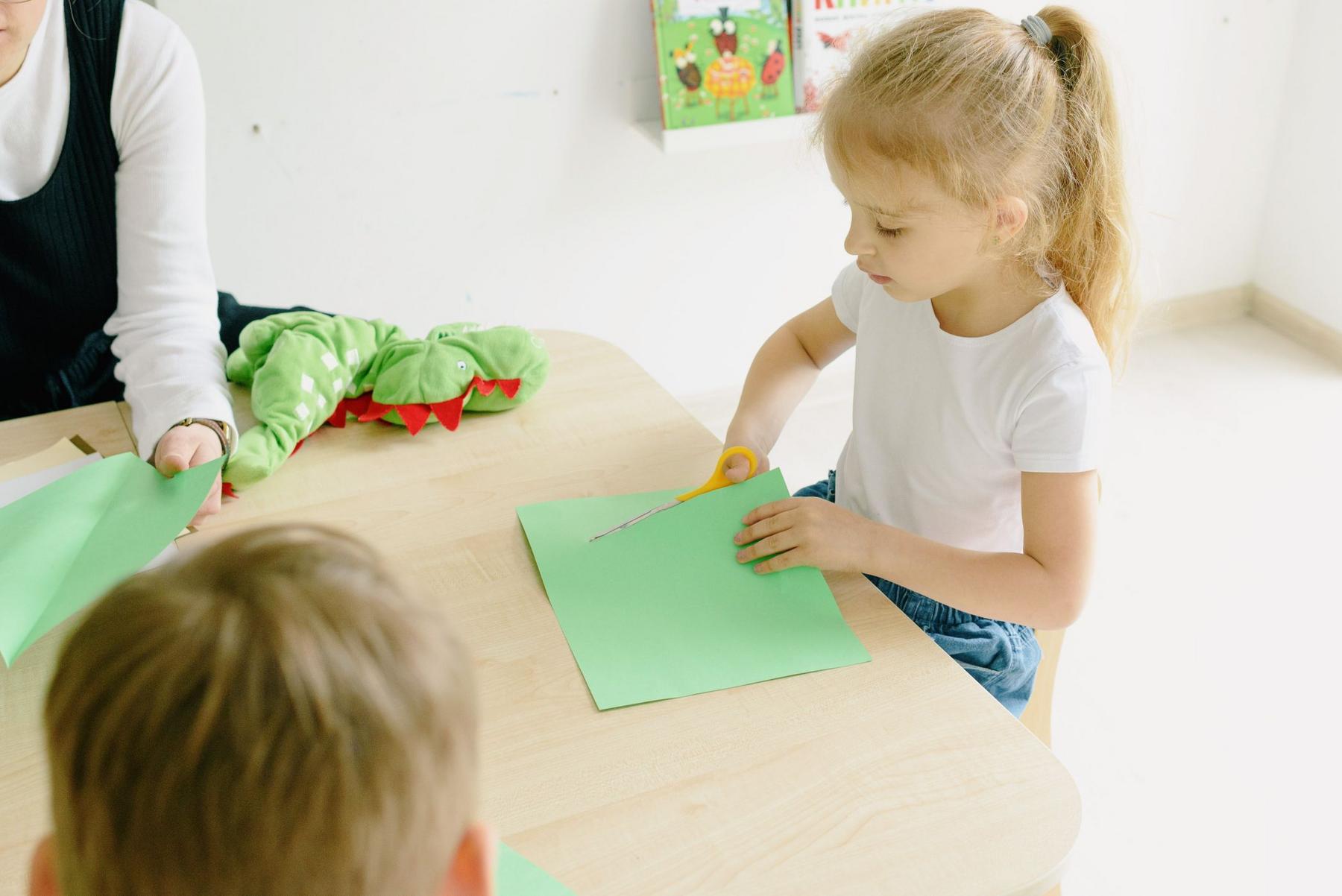
Cutting skills develop through a predictable, sequential progression that typically begins around 2.5 to 3 years of age. Importantly, this progression depends on a set of foundational pre-cutting abilities that must be in place before scissors are introduced.
Pre-Cutting Foundations
Before formal scissor training begins, individuals need to develop:
- Good sitting balance and upright posture
- Established hand dominance
- Bilateral coordination – the ability to use both hands simultaneously for different tasks
- Isolated movement of the thumb, index, and middle fingers
- Adequate hand muscle strength
- Visual-motor integration and hand-eye coordination
Research from occupational therapy settings recommends 15 to 30 minutes of daily fine motor activities for children aged two to six years to support optimal development. Short, frequent practice sessions – ideally 10 to 15 minutes daily – yield better outcomes than single longer sessions.
The Developmental Sequence for Cutting Skills
| Stage | Approximate Age | Skill Description |
|---|---|---|
| 1. Single Snipping | 2.5–3 years | Opening and closing scissors with a snipping motion on paper or play dough |
| 2. Forward Consecutive Cutting | 3+ years | A series of continuous snips to cut across a page |
| 3. Straight Line Cutting | 3.5–4 years | Cutting along a thick guideline |
| 4. Circle Cutting | 4–5 years | Cutting on a curved line of a circle shape |
| 5. Square Cutting | 4.5+ years | Cutting on the line of a square with corners |
| 6. Complex Shapes and Curves | 5+ years | Progressing to zigzags, curves, and detailed decorative shapes |
Occupational therapy guidelines generally suggest that scissors skills are ideally introduced around four years of age, when hand development is ready for proper grasp control. That said, every individual’s trajectory is unique, and readiness should always be assessed on an individual basis.
What Activities Help With Improving Cutting Skills for Arts and Crafts Projects?
A thoughtful, graded approach to activity selection is one of the most effective ways to build cutting skills. Activities should begin at the individual’s current level and progressively increase in complexity.
Building Pre-Scissor Strength
The following activities develop the hand strength and coordination needed for successful cutting:
- Squeezing therapy putty or stress balls
- Manipulating play dough – squeezing, rolling, and pinching
- Using tongs or tweezers to pick up small objects
- Threading large beads onto string
- Using clothespegs or chip clips for hand-strengthening
- Single-hole punching activities
- Tearing and ripping paper for collage work
- Building and manipulating construction toys
Snipping and Line-Cutting Activities
Once scissor grasp has been established, begin with snipping on materials that provide good sensory feedback:
- Play dough sausages – cut into small pieces
- Drinking straws – snip into segments for threading
- Paper fringes – snip around the edges of construction paper
- Graduated line-cutting tasks – beginning with thick, bold lines and progressively reducing to thinner, more precise guidelines
An important tip from occupational therapy practice: thicker, stiffer paper is generally easier for beginners to cut than floppy paper, as it provides better resistance and tactile feedback.
Craft-Based Cutting Projects
Integrating cutting practice into meaningful projects keeps engagement high and makes the activity purposeful:
- Collage work using various paper types
- Paper chains – cutting and linking strips of coloured paper
- Snowflake making – folding and cutting paper symmetrically
- Magazine picture cutting for scrapbooks or art projects
- Decorative fringes for puppets, masks, or greeting cards
- Confetti making – snipping coloured paper into small pieces
How Should Scissors Be Held and Used Safely?
Correct scissor technique is critical for both effectiveness and safety. Occupational therapists typically guide individuals through the following grip and positioning approach.
Correct Scissor Grasp
- Place the thumb through the smaller loop
- Place the middle finger (and ring or little fingers if space allows) through the larger loop
- Position the index finger underneath the larger loop for stabilisation and guidance
- Maintain a “thumbs up” position – thumb on top, not underneath – when holding both the scissors and paper
Left-handed individuals must use true left-handed scissors. Right-handed scissors used in the left hand prevent effective cutting due to blade design, and will lead to frustration rather than skill-building.
Positioning and Posture
- Sit upright with both feet flat on the floor
- Position the table at elbow height when arms are bent at 90 degrees
- Keep elbows tucked against the body, not raised out to the sides
- Always cut away from the body
Core Safety Rules
- Children should always be supervised by an adult
- Scissors are only for cutting designated materials – never for other uses
- Always remain seated when using scissors
- Never carry scissors while walking – hold blades closed in a fist with handles facing outward
- Always pass scissors handle-first to another person
- Never attempt to catch dropped scissors – let them fall and retrieve safely
How Do Adaptive Tools Support Cutting Skills for Different Abilities?
Choosing the right tools can fundamentally change a person’s experience of cutting. Occupational therapy practice emphasises that the right equipment should match the individual’s hand size, strength, and functional ability.
Scissor Selection Considerations
- Child-sized scissors are essential for children – loops and blade length must match the child’s hand size
- Blunt-tipped scissors are generally recommended to reduce injury risk without compromising cutting ability – however, the blades must still be sharp enough to cut paper effectively; dull blades create excessive resistance and frustration
- Spring-loaded scissors automatically reopen after each cut, reducing hand fatigue – beneficial for children learning to cut, and for adults with reduced hand strength or arthritis
- Loop scissors feature larger handles for easier gripping
- Tandem scissors (double-handled) allow an adult to assist while the child operates the other handle
Adaptive Options for Accessibility
For individuals with limited dexterity or grip strength:
- Foam tubing slid over scissor handles increases grip diameter and comfort
- Duct tape wrapped around handles achieves a similar effect
- One-handed cutting tools support those with unilateral hand function
- Rotary cutters reduce repetitive hand stress through a rolling motion
- Adaptive scissors with wider loops ease finger insertion for those with reduced range of motion
How Can Occupational Therapy Support Cutting Skills Development?
Occupational therapy offers a structured, individualised approach to assessing and improving cutting skills across all ages and ability levels. Whether working with a child who is developing cutting skills for the first time, a young person with a disability, or an older adult seeking to maintain fine motor independence, an occupational therapist can tailor an intervention programme to specific goals and needs.
Assessment typically covers scissor grasp, ability to follow a guideline while cutting, paper manipulation with the non-dominant hand, seated positioning, cut smoothness and control, and signs of hand fatigue.
Intervention draws on evidence-based progressions – beginning with foundational pre-scissor activities, moving through developmental stages, and embedding practice into meaningful, goal-oriented craft projects. Caregiver and support person training is often included to extend practice into everyday environments.
For NDIS participants across Queensland, Victoria, New South Wales, and Tasmania, occupational therapy services to support cutting skills development may be funded under the Capacity Building – Improved Daily Living support category. Astrad Allied Health provides mobile occupational therapy services across Brisbane, North Lakes, the Gold Coast, Sunshine Coast (including Peregian Springs, Noosa, Buderim, and Gympie), Sydney, and Melbourne, as well as telehealth services across QLD, VIC, NSW, and TAS for eligible clients.
Making Progress Through Purposeful Practice
Improving cutting skills for arts and crafts projects is not simply about learning to use scissors – it is about building the fine motor capacity, confidence, and independence to participate fully in creative activities and everyday life. A developmental, graded approach that prioritises correct technique, appropriate tools, meaningful activities, and consistent practice creates the conditions for genuine and lasting progress.
Whether you are supporting a child in their developmental journey, an adult navigating disability, or an older person staying engaged and independent through the arts, cutting skills are within reach – and the benefits extend well beyond the craft table.
What age should a child start learning cutting skills for arts and crafts?
Most children begin developing cutting skills between 2.5 and 3 years of age, with formal scissor use typically introduced around four years old. However, readiness varies by individual.
How can I help improve cutting skills at home for arts and crafts projects?
Start by building hand strength with activities such as play dough manipulation, using tongs, and clothepeg exercises. Progress gradually from simple snipping tasks to more complex cutting exercises through short daily practice sessions.
Can occupational therapy help with cutting skills in Brisbane, the Gold Coast, and Sunshine Coast?
Yes, occupational therapists in these areas—as well as via telehealth for eligible clients—offer assessments and tailored interventions to improve cutting skills and fine motor function.
Are cutting skills relevant for NDIS participants?
Absolutely. Developing cutting skills is often supported under the Capacity Building – Improved Daily Living category within NDIS, as it promotes functional independence and fine motor development.
What scissors are best for someone with reduced hand strength or arthritis?
Spring-loaded scissors or loop scissors with wider, easier-to-grip handles are recommended. Additionally, adaptations like foam tubing or duct tape on handles can improve grip comfort. An occupational therapist can provide personalized advice.