The kitchen is far more than a place to prepare meals—it’s a space where independence, dignity, and daily life intersect. Yet for many Australians living with mobility challenges, disabilities, or age-related changes, the kitchen can become a barrier to the autonomy they value most. When reaching for a cupboard becomes dangerous, when transferring hot dishes risks burns, or when navigating the space requires assistance, the heart of the home transforms into a source of frustration and potential harm. Kitchen accessibility upgrades represent a pathway back to independence, enabling individuals across Queensland, New South Wales, Victoria, and Tasmania to reclaim control over one of life’s most fundamental activities: nourishing themselves and their families.
Why Do Kitchen Accessibility Upgrades Matter for Independence and Safety?
Kitchen accessibility upgrades serve a purpose that extends well beyond convenience—they fundamentally reshape how individuals with disabilities or mobility limitations engage with their daily lives. The statistics tell a compelling story: approximately 19% of falls involving older Australians occur in the kitchen, making it one of the most hazardous rooms in the home. These falls aren’t merely accidents; they represent barriers to independence that can precipitate premature moves to residential care facilities.
When occupational therapists assess kitchen accessibility, they examine how the environment either supports or inhibits meaningful occupation. The ability to prepare meals independently influences psychological well-being, self-efficacy, and sense of purpose in profound ways. Kitchen accessibility upgrades directly address these factors by reducing physical demands, minimising fall risks, and enabling continued participation in valued activities.
The impact extends to caregivers as well. When kitchens lack appropriate accessibility features, family members or support workers must provide increased assistance, creating physical demands that can lead to caregiver strain and burnout. Well-designed kitchen accessibility upgrades reduce this reliance, allowing both the individual and their support network to experience greater quality of life.
For NDIS participants, kitchen accessibility upgrades may qualify for funding when they’re deemed “reasonable and necessary” to support disability-related goals. This framework recognises that environmental modifications can be as critical as therapy interventions in enabling independence and participation.
What Are the Essential Physical Features in Kitchen Accessibility Upgrades?
Understanding the physical components of kitchen accessibility upgrades helps clarify what transforms a standard kitchen into an accessible one. These modifications address specific functional limitations while incorporating universal design principles that benefit all users.
Circulation Space and Layout
The foundation of accessible kitchen design begins with adequate space for movement. Wheelchair users require a minimum turning diameter of 1,500mm for full rotation, whilst aisle widths should measure at least 900mm for basic accessibility—though 1,050-1,200mm provides more comfortable movement. These measurements align with Australian Standards AS1428.1, ensuring compliance whilst maximising functionality.
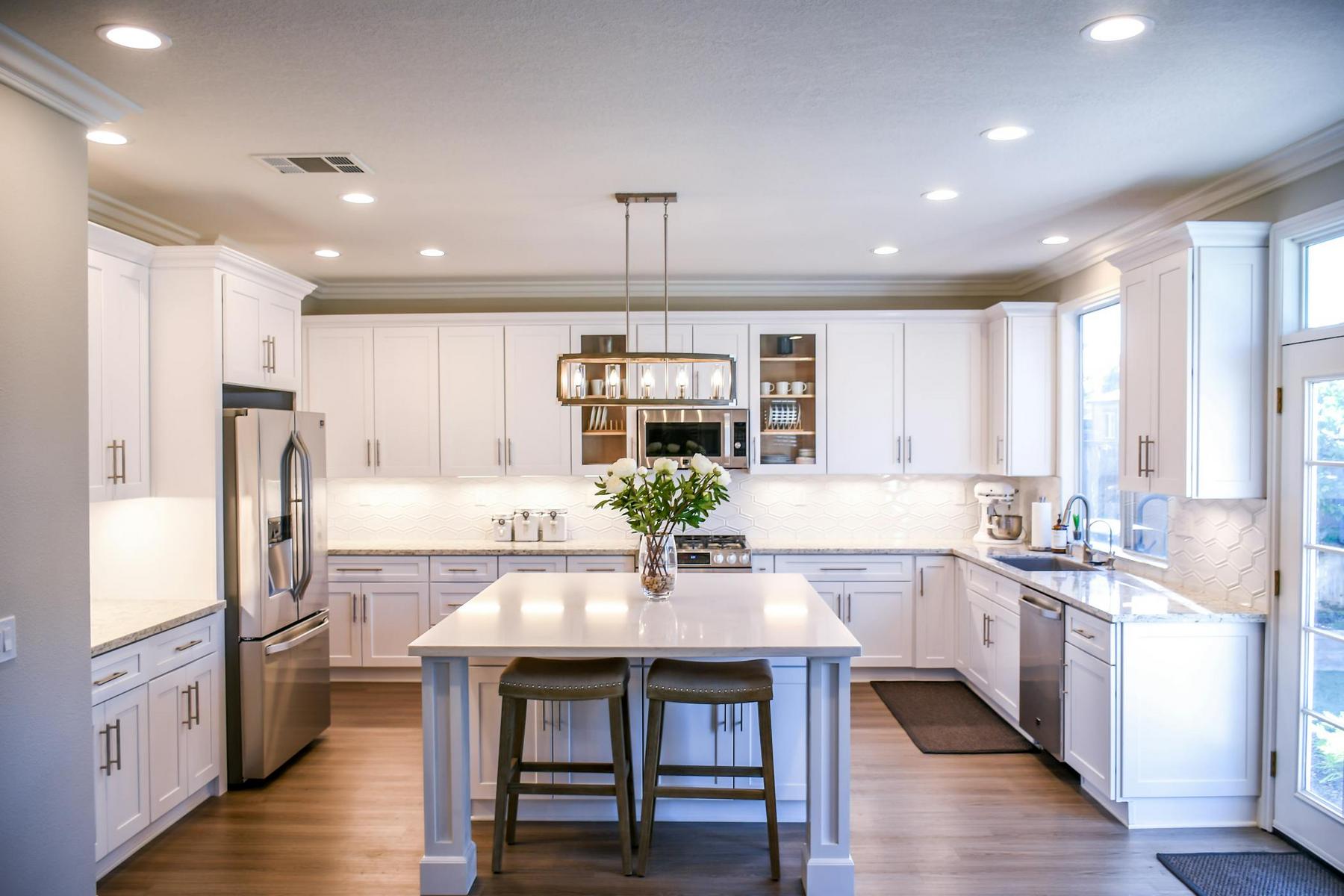
Kitchen layout significantly influences accessibility. U-shaped configurations allow continuous worktops, enabling users to slide items rather than lift them—a critical safety feature when handling hot dishes. L-shaped kitchens offer independent work stations whilst maintaining accessible turning movement. Conversely, galley-style kitchens requiring transfers between opposing sides create burn risks for wheelchair users navigating with hot items.
Counter Heights and Work Surfaces
Standard benchtop heights of 900mm suit standing users but create barriers for wheelchair users or those working whilst seated. Kitchen accessibility upgrades often incorporate multi-level countertops, with heights ranging from 760-860mm for seated work. The NDIS Specialist Disability Accommodation (SDA) Design Standard recommends height-adjustable benchtops with a minimum 300mm range of motion between 720-1,020mm from finished floor level.
Equally important is knee space beneath counters. Minimum clearance of 685-760mm height and 480mm depth allows wheelchair users to position themselves for food preparation tasks. This knee space proves essential at sinks and cooktops, enabling seated participation in cooking activities.
| Kitchen Feature | Standard Dimension | Accessible Dimension | Benefit |
|---|---|---|---|
| Benchtop Height | 900mm | 760-860mm (adjustable preferred) | Enables seated work, reduces reaching |
| Aisle Width | 900mm minimum | 1,050-1,200mm | Accommodates wheelchairs, mobility aids |
| Turning Diameter | Variable | 1,500mm minimum | Allows full wheelchair rotation |
| Knee Space (Height) | N/A | 685-760mm | Permits wheelchair positioning |
| Upper Cabinet Height | 500-600mm above bench | 350mm above bench maximum | Reduces overhead reaching |
| Sink Depth | 250mm+ | 150-200mm | Minimises reaching into basin |
Appliance Selection and Positioning
Appliance choices significantly influence kitchen safety and accessibility. Induction cooktops represent a substantial advancement for kitchen accessibility upgrades because they only generate heat when cookware is present, dramatically reducing burn risks. Front-mounted controls eliminate the need to reach across hot surfaces, whilst staggered burner arrangements minimise stretching.
Wall-mounted ovens positioned at appropriate heights (typically 750-800mm for wheelchair users) eliminate dangerous bending to floor level. Side-hinged oven doors prove preferable to drop-down doors, preventing the need to reach over hot surfaces. Fully telescopic shelves allow users to access oven contents without extending their arms deep into the hot cavity.
Refrigerator selection matters considerably. Side-by-side or French door models provide access to both fresh and frozen compartments without excessive bending—a marked improvement over traditional top-and-bottom freezer designs. Adequate clearance of at least 1,200mm allows wheelchair manoeuvring whilst doors are open.
Raised dishwashers positioned 380-450mm from the floor substantially reduce bending demands compared to standard installations that require reaching to 100-125mm from floor level. This seemingly simple modification can prevent years of back strain for individuals with mobility or endurance challenges.
How Do Storage Solutions Impact Kitchen Accessibility?
Storage represents one of the most frequently overlooked aspects of kitchen accessibility upgrades, yet it profoundly influences independence. Traditional fixed shelving in upper and lower cabinets creates accessibility barriers through excessive reaching, bending, and stretching—movements that become increasingly difficult or impossible with mobility limitations.
Innovative Storage Modifications
Pull-out shelving systems bring cabinet contents to the user rather than requiring them to reach into deep spaces. These systems prove particularly valuable in lower cabinets, where users can access items whilst minimising bending. For upper cabinets, pull-down shelving or motorised wall cabinets that lower at the touch of a button eliminate overhead reaching entirely.
Lazy Susans and corner carousels address the challenge of corner cabinet accessibility. These rotating systems make items visible and reachable without requiring users to stretch into awkward spaces. Vertical lifting systems with hydraulic mechanisms can automatically raise or lower shelves, though these more sophisticated solutions typically suit users with significant mobility limitations.
The principle guiding storage in kitchen accessibility upgrades is straightforward: locate items based on frequency of use, with daily items positioned between 400-600mm height and frequently used items within easy reach. This organisational approach, combined with appropriate storage hardware, enables independence whilst reducing injury risk.
Drawer-based storage offers inherent accessibility advantages over traditional cabinets. Deep drawers with full-extension slides allow users to see and access contents easily, particularly beneficial for those with mobility limitations. When combined with D-shaped pulls or loop handles—easier to grip than round knobs—drawer systems become accessible to individuals with limited hand function or arthritis.
What Funding Options Exist for Kitchen Accessibility Upgrades in Australia?
Understanding funding pathways for kitchen accessibility upgrades helps individuals and families navigate the financial aspects of home modifications. For NDIS participants, kitchen modifications fall within home modification funding, categorised by complexity and cost.
NDIS funding Categories
Minor Modifications (Under $10,000) encompass non-structural changes such as lever taps, grab rails, and modest adjustments to existing fixtures. These modifications require assessment by a qualified occupational therapist but generally proceed through a streamlined approval process.
Minor to Moderate Modifications ($10,000-$20,000) include more extensive kitchen adjustments such as benchtop modifications, cabinet reconfigurations, and appliance repositioning. These require assessment by an occupational therapist with home modification qualifications.
Complex Modifications (Over $20,000) involve structural changes and comprehensive kitchen renovations. These require detailed assessment, two itemised quotes, building compliance certification, and may necessitate planning permits. The assessment process involves collaboration between occupational therapists and building professionals.
For modifications to receive NDIS funding, they must satisfy the “reasonable and necessary” criteria. This means kitchen accessibility upgrades must directly relate to the participant’s disability, support identified goals, represent value for money, and demonstrate sustainability—typically requiring participants to remain in the residence for a minimum of five years for major modifications.
What NDIS Covers and Excludes
NDIS funding for kitchen accessibility upgrades encompasses lowered or height-adjustable benchtops, accessible storage solutions, specialised tapware, positioning modifications for wheelchair access, and safety-related appliance changes such as induction cooktops. Electrical and plumbing works necessary to support these modifications receive funding, as does non-slip flooring when directly related to disability needs.
However, NDIS doesn’t fund aesthetic upgrades, general kitchen renovations unrelated to disability function, or appliances purchased primarily for household convenience rather than disability-specific requirements. This distinction ensures funding targets modifications that genuinely enable independence and safety rather than general home improvement.
Alternative Funding Sources
Beyond NDIS, aged care recipients may access funding through Commonwealth Home Support Programme (CHSP) or Home Care Packages. These programmes support minor to moderate modifications enabling older Australians to remain independent at home. Private clients may pursue kitchen accessibility upgrades independently, potentially accessing tax deductions for medical-related home modifications.
Veterans may qualify for home modification assistance through the Department of Veterans’ Affairs, whilst some state governments offer specific programmes supporting home modifications for residents with disabilities or aged individuals.
How Does Professional Assessment Improve Kitchen Accessibility Outcomes?
professional occupational therapy assessment forms the cornerstone of effective kitchen accessibility upgrades. Research demonstrates that occupational therapy-led fall prevention interventions produce significant reductions in post-intervention falls, whereas interventions conducted by trained assessors without occupational therapy background show no significant reduction. This evidence underscores the value of professional assessment in kitchen modification planning.
Comprehensive Assessment Components
Occupational therapists conducting kitchen assessments examine multiple factors simultaneously. Physical considerations include mobility patterns throughout the space, standing balance and endurance, upper and lower limb strength, range of motion, and fine motor coordination. These physical factors determine appropriate heights, clearances, and equipment selections.
Cognitive assessment evaluates the individual’s ability to plan and sequence cooking tasks, remember steps, make decisions, and maintain awareness of safety hazards. These factors influence design elements such as control complexity, labelling requirements, and the necessity for safety features like automatic shut-offs.
Perceptual and sensory assessment addresses vision (including visual acuity, peripheral vision, and contrast sensitivity), hearing, proprioception, and spatial awareness. These factors guide decisions about lighting, colour contrast, tactile features, and visual cues throughout the kitchen.
Environmental assessment examines the existing kitchen layout, appliance placement, storage organisation, lighting adequacy, floor conditions, and available space for modifications. This holistic approach ensures kitchen accessibility upgrades address all barriers to independence rather than isolated challenges.
Performance-Based Evaluation
Skilled occupational therapists often employ standardised assessment tools that observe actual kitchen task performance. The Kitchen Task Assessment (KTA) evaluates cognitive and functional performance during cooking activities, whilst the Assessment of Motor and Process Skills (AMPS) focuses on motor and process skills in meal preparation contexts. These performance-based assessments provide more accurate information than questionnaires alone, revealing subtle difficulties that individuals might not recognise or report.
This evidence-based assessment approach ensures kitchen accessibility upgrades target the specific barriers limiting each individual’s independence, rather than applying generic modifications that may not address their unique needs.
What Safety Features Should Kitchen Accessibility Upgrades Prioritise?
Safety considerations permeate every aspect of kitchen accessibility upgrades, as the kitchen environment presents multiple hazards including falls, burns, scalds, and fire risks. Evidence-based modifications address these dangers systematically.
Fall Prevention Strategies
Research indicates home modifications reduce fall risk by approximately 21% overall, with more substantial reductions (39%) for populations with previous falls and vision impairments. Kitchen accessibility upgrades targeting fall prevention include non-slip flooring with appropriate coefficient of friction ratings, elimination of level changes and raised thresholds, adequate lighting incorporating ambient, task, and accent layers, and clear pathways free from clutter.
Cork, linoleum, rubber, and textured vinyl represent recommended flooring options. Smaller tiles prove superior to large tiles for wheelchair users, as more grout lines provide traction and better manage tyre pressure. Polished natural stone, high-gloss hardwood, and polished ceramic should be avoided due to slip risks.
Burn and Scald Prevention
Kitchen accessibility upgrades incorporate multiple features preventing burns and scalds. Induction cooktops eliminate heat when cookware isn’t present, front-mounted controls prevent reaching over burners, and staggered burner arrangements reduce stretching across hot surfaces. Heat-resistant pull-out shelves positioned near ovens enable safe hot dish transfer without carrying items long distances.
Thermostatic mixing valves limit maximum water temperature, preventing scalding at taps—particularly important for individuals with reduced sensation or cognitive impairments affecting judgment. Insulated pipes below knee-space sinks prevent burns for wheelchair users whose legs might contact exposed plumbing.
Integrated Safety Systems
Comprehensive kitchen accessibility upgrades consider emergency response capabilities. Smoke detectors with appropriate placement and regular maintenance, accessible fire extinguishers and fire blankets, adequate ventilation systems, and clear emergency egress routes form essential safety infrastructure. For individuals with cognitive impairments, automatic stove shut-off systems prevent fire hazards from forgotten burners.
Creating Kitchens That Enable Life’s Essential Activities
Kitchen accessibility upgrades represent far more than physical modifications to benchtops, appliances, and storage. They embody a commitment to independence, dignity, and continued participation in activities that give life meaning and purpose. When kitchens transform from spaces of limitation into centres of capability, individuals reclaim not just the ability to prepare meals, but their sense of autonomy and self-determination.
The research evidence is unequivocal: professional occupational therapy assessment combined with evidence-based kitchen accessibility upgrades reduces fall risks, enables independent meal preparation, prevents premature admission to residential care, and significantly improves quality of life. For individuals across Brisbane, North Lakes, Sydney, Melbourne, the Gold Coast, and the Sunshine Coast, these modifications make the difference between dependence and independence, between risk and safety, between isolation and engagement.
Effective kitchen accessibility upgrades require comprehensive assessment addressing physical, cognitive, sensory, and environmental factors. They demand professional guidance ensuring modifications are safe, practical, sustainable, and appropriately funded through schemes like the NDIS or aged care programmes. Most importantly, they must reflect the individual’s unique goals, preferences, and circumstances—because accessible design succeeds when it enables each person’s specific vision of independence.
Universal design principles remind us that modifications benefiting individuals with disabilities ultimately benefit everyone. Multi-level benchtops serve wheelchair users whilst reducing strain for standing users of different heights. Enhanced lighting assists those with vision impairments whilst creating safer conditions for all. Non-slip flooring protects individuals with balance challenges whilst preventing accidents for every family member.
As Australia’s population ages and disability awareness grows, kitchen accessibility upgrades will increasingly become standard rather than specialised. The principles established today—adequate space, appropriate heights, intuitive controls, comprehensive safety features, and flexible design—will shape how future generations approach kitchen design for all Australians, regardless of ability.
What are the most cost-effective kitchen accessibility upgrades to start with?
The most cost-effective kitchen accessibility upgrades include lever-style tap handles, non-slip adhesive strips for flooring, grab bar installation in key areas, motion-activated lighting, and rocker-style light switches. Additionally, pull-out shelving systems and under-cabinet lighting provide moderate investments that enhance accessibility.
How long does NDIS approval take for kitchen accessibility upgrades?
NDIS approval timeframes vary based on the complexity of the modifications. Minor upgrades under $10,000 might be approved within 2-4 weeks following an occupational therapy assessment, while more complex modifications may take 6-12 weeks or longer due to the need for detailed documentation, multiple quotes, and building compliance checks.
Can kitchen accessibility upgrades be installed in rental properties?
Yes, but they require landlord approval and careful consideration of reversibility. For rental properties, it’s advisable to use portable or temporary modifications—such as grab bars or reversible adjustments—that can be removed if needed. Written consent from the landlord is essential before starting any modifications.
Do kitchen accessibility upgrades increase home value in Australian property markets?
Well-executed kitchen accessibility upgrades can help maintain or even increase home value by appealing to a broader market, including buyers looking to age in place or accommodate family members with special accessibility needs. However, highly specialised modifications might limit appeal unless they are designed to be adjustable or reversible.
What’s the difference between kitchen accessibility upgrades and universal design?
Kitchen accessibility upgrades focus on addressing specific barriers for individuals with disabilities, such as lower benchtops or adjustable storage, whereas universal design creates environments that are usable by everyone regardless of age or ability. Effective designs often integrate both approaches to provide functionality for current needs and flexibility for future changes.