Creating a safe, accessible home shouldn’t feel like an impossible dream. For many Australians living with disability, everyday tasks like showering, moving between rooms, or accessing the kitchen can present significant challenges. The right home modifications can transform these daily struggles into moments of independence and dignity. Understanding what the National Disability Insurance Scheme (NDIS) funds—and how to access this support—is the first step toward creating a home that truly works for you.
With 751,446 active NDIS participants across Australia as of September 2025, home modifications represent one of the most significant investments in long-term independence and quality of life. Yet navigating the approval process, understanding eligibility criteria, and knowing which modifications are funded can feel overwhelming. This comprehensive guide breaks down common home modifications funded by NDIS, helping participants and families make informed decisions about creating accessible living environments.
What Are Home Modifications Under the NDIS?
Home modifications are structural or non-structural changes made to a participant’s residence to improve safety, accessibility, and independence. Unlike assistive technology or consumables, home modifications fall under Capital Supports in NDIS plans—they’re considered long-term investments in creating environments where people with disability can live more independently.
The purpose of these modifications extends beyond physical accessibility. They reduce reliance on carers, minimise injury risk from falls or accidents, enable participation in daily activities, and support participants in achieving their NDIS goals. Whether it’s widening doorways for wheelchair access, installing grab rails in bathrooms, or creating step-free entries with ramps, each modification addresses specific functional challenges caused by disability.
The NDIS categorises modifications into three distinct levels based on cost, complexity, and structural risk. Understanding these categories helps participants know what assessments, quotes, and approvals they’ll need before commencing work.
Categories of NDIS Home Modifications
| Category | Cost Range | Description | Assessment Required | Quotes Needed |
|---|---|---|---|---|
| Category A (Minor) | Under $10,000 | Non-structural changes with minimal risk. Examples: grab rails, lever taps, handheld showers, threshold ramps | Qualified occupational therapist | Generally not required (except remote areas) |
| Category B (Minor) | $10,000-$20,000 | Non-structural changes with higher scope. Examples: comprehensive kitchen adjustments, bathroom fixture relocation | Home modification assessor with occupational therapy qualifications | Generally not required |
| Complex | Over $20,000 | Structural changes requiring permits. Examples: permanent ramps, bathroom renovations, lifts, load-bearing wall removal | Complex assessment by occupational therapist with appropriate home modification assessment qualifications + building professional | Two itemised quotes required |
It’s important to note that Category A and B modifications are funded based on market rates in the participant’s geographic area, using the Modified Monash Model for regional classification. Complex modifications over $30,000 require an NDIS-registered Building Works Project Manager to oversee the project from planning through completion.
Which Home Modifications Does the NDIS Fund Most Commonly?
Bathroom Modifications: The Most Frequently Funded Changes
Bathroom modifications represent the most common home modifications funded by NDIS. This makes sense when you consider that bathrooms present the highest injury risk due to wet surfaces, confined spaces, and the physical demands of bathing and toileting.
Shower modifications often include removing bathtubs to install walk-in or roll-in showers with step-free access. The flooring must meet minimum slip resistance ratings (P3 or R10), and installations typically incorporate handheld showerheads at adjustable heights, grab rails strategically positioned for safe transfers, and thermostatic mixing valves to prevent scalding injuries. For participants using wheelchairs, corner shower installations require a minimum 900mm x 900mm clear recess to enable safe manoeuvring.
Toilet modifications focus on safe transfers and independence. This includes accessible toilet positioning, wall-mounted or drop-down grab rails, raised toilet seats where appropriate, and sometimes repositioning existing toilets to improve circulation space. Some participants may receive funding for bidet or wash function toilets, though only base-level functionality is covered—premium features fall outside NDIS funding parameters.
Basin and sink modifications address height and reach limitations. Lowered hand basins benefit wheelchair users, with appropriate knee and foot clearance underneath. Mixer taps or lever handles replace traditional taps that require grip strength and dexterity. The NDIS funds functional changes to accessible vanities, though cosmetic upgrades like decorative tiles or luxury fittings aren’t included unless they’re integral to the functional modification.
Additional bathroom accessibility improvements include door widening to a minimum 900-950mm clear opening for wheelchair access, threshold ramps where door thresholds exceed 5mm, improved lighting with visual contrasts for people with low vision, and wall reinforcement to support grab rail installation. Ventilation systems may be funded to manage moisture and prevent mould growth that could affect respiratory health.
Kitchen Modifications for Independent Living
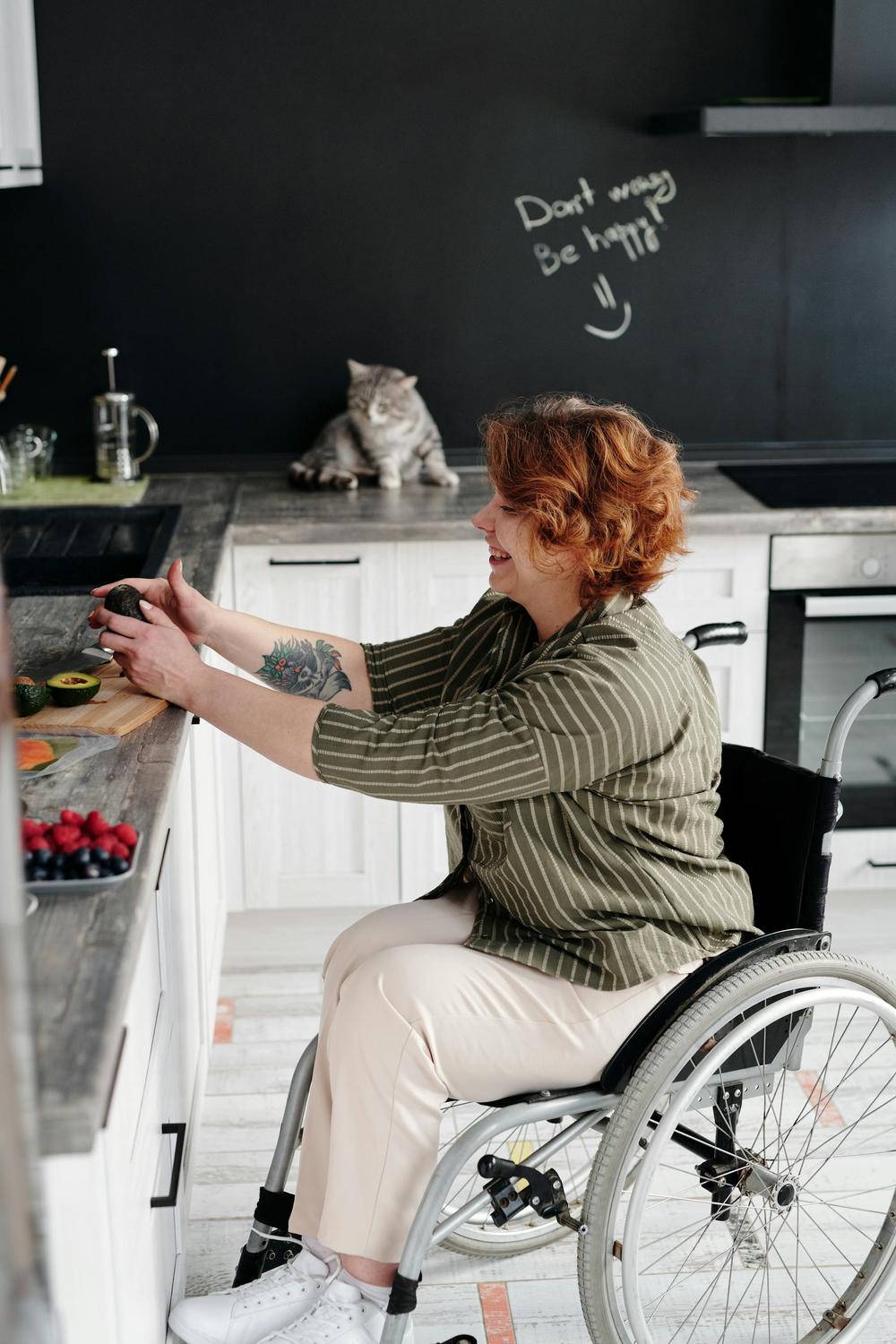
Kitchen modifications are funded when disability prevents safe or independent kitchen use. Common modifications include lowered benchtops or sinks for wheelchair users, pull-out or adjustable shelves and drawers that reduce reaching demands, and accessible appliance placement. Lever-style taps help individuals with limited hand function, while accessible switches and controls reduce strength and reach requirements.
Some participants benefit from mobile kitchen benches on castors with height adjustment capabilities, or roll-out shelves replacing hard-to-reach cabinets. However, the NDIS doesn’t fund new appliances, cabinetry upgrades for aesthetic reasons, or general kitchen improvements unrelated to functional disability needs.
Ramps and External Access: Enabling Home Entry
Ramps rank among the most common home modifications funded by NDIS, addressing one of the most fundamental accessibility barriers—getting in and out of the home safely.
Ramp specifications must comply with Australian Standard AS1428.1. Standard access ramps require a 1:14 gradient (one metre of rise per 14 metres of length), while short threshold ramps can use a steeper 1:8 gradient for maximum heights of 190mm. The minimum clear width is 1000mm excluding handrails, with landing areas of at least 1200mm at the base, top, and every nine metres along the ramp length. Direction changes require 1500mm x 1500mm landings.
All ramps must feature non-slip surfaces, handrails on both sides at heights between 865-1000mm, and for permanent concrete ramps, a minimum thickness of 100mm for long-term durability. Permanent outdoor ramps require building permits, while portable ramps without structural changes may not.
Beyond ramps, external access modifications include concrete pathways (minimum 1000mm wide with slip-resistant surfaces), platform lifts for situations where ramps become impractical due to height or space limitations, and handrails on external walkways.
Doorway and Circulation Modifications
Door widening represents one of the most straightforward yet impactful modifications funded through the NDIS. Widening doorways to a minimum 900-950mm clear opening enables wheelchair users and those with mobility aids to move freely throughout their homes. This typically includes access to living areas, bathrooms, bedrooms, and kitchens.
Some participants require automatic door openers if they cannot physically operate doors independently. Video doorbells benefit deaf or hard-of-hearing participants, while voice-activated or sensor-controlled systems for lighting and climate control support various disability types.
Internal circulation modifications encompass non-slip flooring throughout movement areas, threshold ramps to level floor surfaces, hallway widening for mobility aids, and in multi-level homes, stairlifts or platform lifts. Ceiling hoists with appropriate structural support enable safe transfers between levels for participants with significant mobility limitations.
Bedroom and Living Area Modifications
Bedroom modifications often focus on enabling safe equipment use and ensuring bedroom location on the same level as accessible bathrooms where possible. Common modifications include ceiling hoists with structural reinforcement, widened doorways for wheelchair or equipment access, and electrical outlets positioned for medical or disability-related equipment.
In rare cases where temperature regulation is medically necessary due to disability, air conditioning systems may be funded. Flooring modifications ensure equipment can move safely across surfaces, while fire exit modifications address emergency egress requirements.
Stairlifts and Vertical Platform Lifts
When participants cannot safely use stairs and moving to a single-level home isn’t reasonable, stairlifts or vertical platform lifts may be funded. These require formal occupational therapist recommendations, structural reviews, and detailed quotes. The funding covers purchase, installation, and any additional structural modifications needed to support the equipment safely.
All lifts must include backup power systems for safe operation during power outages, and outdoor installations require appropriate weatherproofing to withstand Australian climate conditions.
How Do You Qualify for NDIS-Funded Home Modifications?
Eligibility for NDIS-funded home modifications requires meeting specific criteria that demonstrate the modifications are reasonable and necessary. The NDIS applies stringent assessment principles to ensure funding represents good value and genuinely addresses disability-related needs.
Essential Eligibility Criteria
Related to disability: The modification must directly address challenges caused by the participant’s disability, not general home improvements or maintenance that any homeowner might undertake.
Reasonable and necessary: This foundational NDIS principle requires modifications to be cost-effective, safe, demonstrably improve independence or safety, and be necessary for daily functioning. The NDIS weighs modifications against alternative solutions, such as assistive technology or increased support worker hours.
Supports NDIS goals: Modifications must align with goals documented in the participant’s NDIS plan, whether related to daily living activities, social participation, or employment.
Effective and beneficial: Participants must demonstrate they’ll benefit from the modification long-term. Short-term or temporary accommodations typically aren’t approved as home modifications.
Legal and safe: All work must comply with Australian Building Codes, National Construction Code requirements, and local council regulations. Non-compliant work cannot receive funding.
Value for money: The NDIS assesses whether the modification represents the most cost-effective solution compared to alternatives. This assessment considers both immediate costs and long-term value.
Property-Specific Requirements
Primary residence: The NDIS more readily funds modifications for a participant’s primary residence where they intend to remain long-term. Second homes or part-time residences face higher scrutiny, though modifications may be approved for shared custody arrangements where children with disability spend substantial time at both parents’ homes.
Property suitability: The home must be structurally sound and suitable for modification. Participants should demonstrate intention to remain in the property for a reasonable period following modification completion.
Rental properties: Written landlord consent is mandatory before the NDIS will consider funding approval. The application must clarify whether the landlord requires modifications to be removed when the lease ends. For strata or body corporate properties, written permission from the body corporate is also required.
Professional Assessment Requirements
A qualified occupational therapist must conduct a comprehensive functional assessment demonstrating how the participant’s disability creates specific barriers in the home environment. This assessment forms the clinical foundation for the funding request, linking modifications directly to functional needs and NDIS goals.
For minor modifications, any qualified occupational therapist can complete the assessment. Complex modifications require an occupational therapist with home modification assessor qualifications, who works collaboratively with building professionals to assess structural feasibility.
What’s the Application Process for Home Modifications?
Understanding the application process for common home modifications funded by NDIS helps participants prepare documentation thoroughly and avoid unnecessary delays.
Step-by-Step Application Process
Initial discussion and planning: Participants typically begin by discussing potential modification needs with their support coordinator, planner, or Local Area Coordinator (LAC). This conversation identifies challenges, explores possible solutions, and determines whether modifications represent the most appropriate support option.
Occupational therapy assessment: An occupational therapist conducts a comprehensive in-person home assessment, typically lasting 1.5-2.5 hours for straightforward cases. The assessment includes observing how the participant moves through their home, completes daily tasks, and identifying specific barriers and safety risks in each room.
The occupational therapist takes measurements, photographs, and detailed notes documenting current challenges. For complex modifications, this initial assessment may involve a licensed builder to assess structural feasibility. The total time commitment for complex modification assessments can exceed 15 hours when including report preparation, concept drawings, and collaborative planning sessions.
Professional report preparation: The occupational therapist prepares a detailed written report with clinical reasoning explaining why specific modifications are necessary. This report links the participant’s functional limitations directly to recommended modifications and explains how changes will support independence, safety, and goal achievement.
For complex work, the report includes concept drawings, floor plans, specific fixture placement recommendations, risk assessments, and detailed measurements.
Obtaining builder quotes: For minor modifications under $20,000, quotes typically aren’t required, though participants should retain any quotes obtained for their records. Complex modifications over $20,000 require two itemised quotes from licensed, NDIS-registered builders. Quotes must include GST, dimensions of work areas, separate costing for each job stage, and descriptions of fixtures including make, model, and individual costs.
Compiling supporting documentation: The complete application package includes the occupational therapist assessment report, builder quotes (if required), proof of property ownership or written landlord consent, mortgage provider approval if applicable, body corporate approval for strata properties, concept drawings for complex work, and any additional relevant documentation.
NDIS submission and review: The support coordinator, plan manager, or participant submits the complete package to the NDIS. Participants must never commence work before receiving formal NDIS approval, as work started prematurely won’t be funded retrospectively.
The NDIA reviews applications against reasonable and necessary criteria, typically within 14 days, though complex cases may take longer. The NDIA may request additional information or clarification during the review process.
Implementation and completion: Once approved, funding is added to the participant’s plan under Capital Supports. Participants engage NDIS-registered builders to complete the work according to approved specifications. Complex modifications over $30,000 require an NDIS-registered Building Works Project Manager to oversee the project.
Following completion, the occupational therapist typically conducts a final inspection to verify modifications meet NDIS requirements and participant needs. The participant receives warranties and training on using new features like hoists or automatic doors.
Common Reasons for Delays or Denials
Applications may experience delays or denials due to inadequate occupational therapy assessments that fail to clearly link modifications to functional needs, missing landlord or property owner approvals, incomplete or poorly detailed builder quotes, inclusion of aesthetic or non-disability-related work, unclear justification against reasonable and necessary criteria, or poor documentation.
Commencing work before receiving formal NDIS approval results in automatic funding denial. Success factors include working with experienced NDIS-approved builders, obtaining thorough occupational therapy assessments, preparing complete documentation packages, and engaging support coordinators or plan managers for application guidance.
What Won’t the NDIS Fund for Home Modifications?
Understanding what the NDIS doesn’t fund is equally important as knowing what receives approval. Clear exclusions help participants avoid disappointment and unnecessary assessment costs.
Aesthetic and Luxury Upgrades
The NDIS doesn’t fund cosmetic finishes, decorative elements, or luxury upgrades, even when incorporated into otherwise fundable modifications. This includes decorative tiles beyond standard functional options, high-end materials or designer fittings, coloured or polished concrete, and wrought iron or stone masonry elements. Participants may choose to pay for upgrades from personal funds, with the NDIS funding the standard-grade alternative cost.
Recreational and Comfort Items
Swimming pools and spas, including hydrotherapy pools, aren’t funded through home modifications. Standard hot water systems, air conditioning except in rare cases of medically necessary temperature regulation, ceiling fans, and general heating systems fall outside NDIS funding parameters. These items are considered standard home comfort features rather than disability-specific necessities.
Home Expansion and Maintenance
The NDIS doesn’t fund building additional rooms, home extensions, or making houses larger. Routine home maintenance, repairs to pre-existing damage outside the modification area, insurance premiums for modified homes, and general home security systems for crime prevention are homeowner responsibilities.
Energy Systems and Utilities
Solar panels, batteries, generators, and standard utility costs aren’t funded. While backup power systems for life-sustaining equipment may receive funding, general household energy improvements fall outside NDIS scope.
Furnishings and General Items
Household furniture, standard appliances, new kitchens or bathrooms unrelated to disability needs, and general household upgrades aren’t considered disability-specific supports. The NDIS funds only those elements of kitchen or bathroom renovations directly required for accessibility and safety.
Non-Compliant or Inappropriate Work
Work that doesn’t meet Australian Building Codes, breaches building regulations, or fails to comply with the National Construction Code cannot receive funding. Similarly, modifications that landlords refuse to permit in rental properties, or work considered the landlord’s responsibility, aren’t funded.
How Can Occupational Therapy Help with Home Modifications?
Occupational therapists play a central role throughout the home modification process, from initial assessment through post-completion verification. Their clinical reasoning, knowledge of building standards, and understanding of NDIS funding criteria make them essential partners in securing appropriate modifications.
Assessment and Clinical Justification
Occupational therapists conduct comprehensive functional capacity assessments linking specific disability impacts to environmental barriers in the home. They observe how participants move through spaces, complete daily activities, and interact with fixtures and fittings. This observation-based assessment provides the clinical foundation for modification recommendations.
The occupational therapist’s report must clearly articulate why each recommended modification is necessary, how it addresses functional limitations, and how it supports the participant’s NDIS goals. This clinical justification demonstrates the modification meets reasonable and necessary criteria.
Collaboration with Building Professionals
For complex modifications, occupational therapists work alongside licensed builders to assess structural feasibility and develop practical solutions. This collaboration ensures recommendations are both clinically appropriate and structurally achievable within budget constraints.
Occupational therapists create detailed drawings, scope of works documents, and cost estimates that guide builder quotes and NDIS applications. They complete the Complex Home Modification assessment template in partnership with building professionals, ensuring all technical and clinical requirements are addressed.
Value for Money Advocacy
Research indicates occupational therapists often face challenges demonstrating value for money to the NDIA, with inconsistent decision-making noted across similar funding applications. Skilled occupational therapists address this by clearly comparing modification costs against alternatives, demonstrating long-term cost-effectiveness, and documenting how modifications reduce ongoing support needs.
Project Oversight and Verification
Throughout the implementation phase, occupational therapists may conduct site visits to ensure work progresses according to approved plans. Following completion, they verify that modifications meet NDIS requirements, participant needs, and relevant building standards. They also provide training on using new features safely and effectively.
Moving Forward: Creating Accessible Homes That Support Independence
Common home modifications funded by NDIS represent more than structural changes—they’re investments in independence, safety, and quality of life. From bathroom modifications that prevent falls to doorway widening that enables wheelchair access, each modification addresses real barriers that impact daily living.
For the 751,446 NDIS participants across Australia, understanding what modifications are commonly funded, how to qualify, and how to navigate the application process empowers informed decision-making. Working with qualified occupational therapists, experienced NDIS-registered builders, and knowledgeable support coordinators increases the likelihood of successful applications and timely project completion.
The NDIS funding of $44.6 billion forecast for 2025-26 reflects the scheme’s commitment to supporting Australians with disability. Research showing a return on investment of $2.25 for every dollar spent demonstrates that well-planned home modifications deliver value beyond individual participants—they reduce long-term care costs, prevent injuries, and enable greater community participation.
Whether you’re considering grab rails in your bathroom, a ramp for home entry, or complex renovations to create fully accessible living spaces, understanding the funding landscape helps you advocate effectively for modifications that will genuinely improve your daily life.
How long does it take to get NDIS approval for home modifications?
The NDIS typically reviews applications within 14 days of receiving complete documentation. However, timelines vary based on the complexity of the modification. Minor modifications may be approved within 4-6 weeks, while complex modifications—requiring structural assessments, multiple builder quotes, and additional documentation—can take several months. Delays often occur due to incomplete paperwork, missing approvals, or requests for further information.
Can I get home modifications approved if I’m renting?
Yes, renters can access NDIS-funded home modifications. However, written landlord consent is mandatory. The application must clarify whether the landlord requires modifications to be removed at the end of the lease. In some cases, temporary or portable modifications may be recommended if permanent changes are not feasible.
What’s the difference between home modifications and assistive technology under NDIS?
Home modifications involve permanent, structural changes—such as installing ramps, widening doorways, or renovating bathrooms—funded under Capital Supports. Assistive technology, on the other hand, includes movable equipment like shower chairs, portable hoists, or mobile ramps, which are funded under separate budget categories.
Do I need to pay anything upfront for NDIS-funded home modifications?
Once the NDIS approves home modifications and funding is added to your plan, you generally do not pay upfront costs for work carried out by NDIS providers who invoice the NDIS directly. However, you may be responsible for any costs exceeding approved amounts or for premium upgrades beyond standard functional modifications.
What happens if my home modification needs change after approval?
If your needs change after approval but before the work begins, you should contact your support coordinator or NDIS planner immediately to discuss amending the approval. Changes after work completion may require a separate application for additional modifications, ensuring that the new needs continue to meet the NDIS’s reasonable and necessary criteria.